Showing posts with label Mobility. Show all posts

Wednesday, June 17, 2015

New exploit turns Samsung Galaxy phones into remote bugging devices

As many as 600 million phones vulnerable to remote code execution attack.
Ryan Welton
As many as 600 million Samsung phones may be vulnerable to attacks that allow hackers to surreptitiously monitor the camera and microphone, read incoming and outgoing text messages, and install malicious apps, a security researcher said.
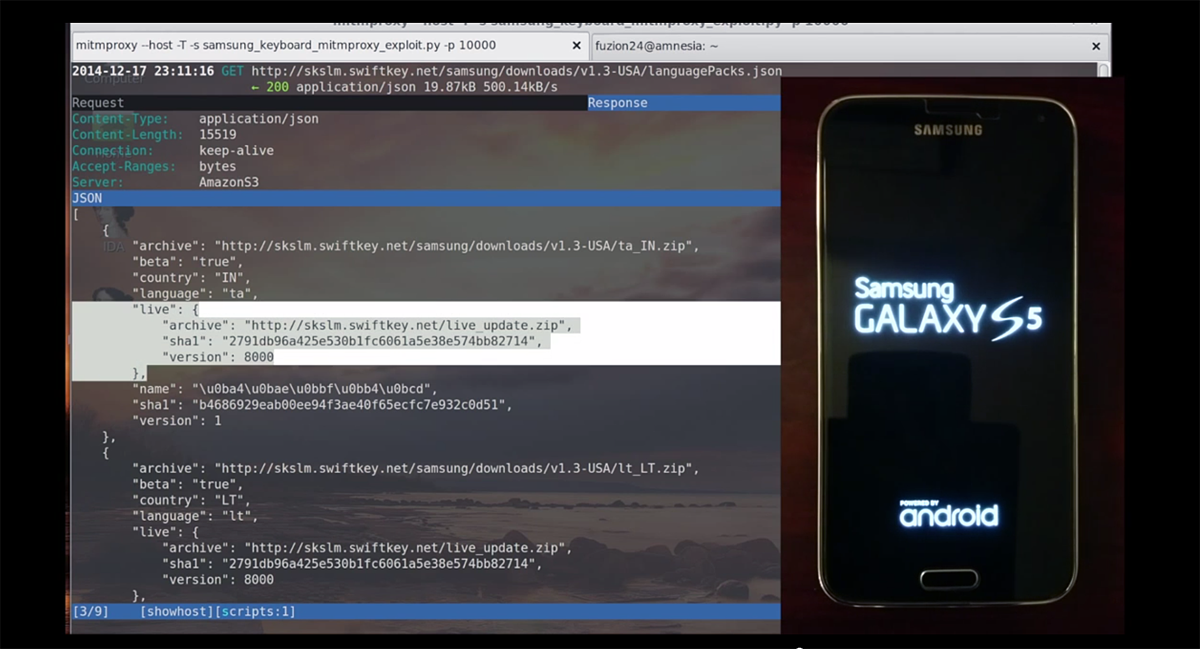
The vulnerability is in the update mechanism for a Samsung-customized version of SwiftKey, available on the Samsung Galaxy S6, S5, and several other Galaxy models. When downloading updates, the Samsung devices don't encrypt the executable file, making it possible for attackers in a position to modify upstream traffic—such as those on the same Wi-Fi network—to replace the legitimate file with a malicious payload. The exploit was demonstrated Tuesday at the Blackhat security conference in London by Ryan Welton, a researcher with security firm NowSecure. A video of his exploit is here.
SamsungKeyboardExploit
Phones that come pre-installed with the Samsung IME keyboard, as the Samsung markets its customized version of SwiftKey, periodically query an authorized server to see if updates are available for the keyboard app or any language packs that accompany it. Attackers in a man-in-the-middleposition can impersonate the server and send a response that includes a malicious payload that's injected into a language pack update. Because Samsung phones grant extraordinarily elevated privileges to the updates, the malicious payload is able to bypass protections built into Google's Android operating system that normally limit the access third-party apps have over the device.
Surprisingly, the Zip archive file sent during the keyboard update isn't protected by transport layer security encryption and is therefore susceptible to man-in-the-middle tampering. The people designing the system do require the contents of that file to match a manifest file that gets sent to the phone earlier, but that requirement provided no meaningful security. To work around that measure Welton sent the vulnerable phone a spoofed manifest file that included the SHA1 hash of the malicious payload. He provided more details about the exploit and underlying vulnerability here and here.
Welton said the vulnerability exists regardless of what keyboard a susceptible phone is configured to use. Even when the Samsung IME keyboard isn't in use, the exploit is still possible. The attack is also possible whether or not a legitimate keyboard update is available. While SwiftKey is available as a third-party app for all Android phones, there's no immediate indication they are vulnerable, since those updates are handled through the normal Google Play update mechanism.
For the time being, there's little people with vulnerable phones can do to prevent attacks other than to avoid unsecured Wi-Fi networks. Even then, those users would be susceptible to attacks that use DNS hijacking, packet injection, or similar techniques to impersonate the update server. There is also no way to uninstall the underlying app, even when Galaxy owners use a different keyboard. In practical terms, the exploit requires patience on the part of attackers, since they must wait for the update mechanism to trigger, either when the phone starts, or during periodic intervals.
Welton said he has confirmed the vulnerability is active on the Samsung Galaxy S6 on Verizon and Sprint networks, the Galaxy S5 on T-Mobile, and the Galaxy S4 Mini on AT&T. Welton has reported to bug to Samsung, Google, and the US CERT, which designated the vulnerability CVE-2015-2865. The bug has its origins in the software developer kit provided by SwiftKey, but it also involves the way Samsung implemented it in its Galaxy series of phones.
Update: In an e-mailed statement, SwiftKey officials wrote: "We’ve seen reports of a security issue related to the Samsung stock keyboard that uses the SwiftKey SDK. We can confirm that the SwiftKey Keyboard app available via Google Play or the Apple App Store is not affected by this vulnerability. We take reports of this manner very seriously and are currently investigating further."
The researcher said Samsung has provided a patch to mobile network operators, but he has been unable to learn if any of the major carriers have applied them. As Ars has reported in the past, carriers have consistently failed to offer security updates in a timely manner.
Post updated in the fourth paragraph to add details about transport layer security and to add comment from SwiftKey in the second-to-last paragraph.

Wednesday, May 6, 2015

Warrants not required for police to get your cell phone cell-site records

Mobile callers' cell-tower history is fair game for cops—probable cause unnecessary.

by David Kravets - May 5, 2015 3:25pm PDT  ars technica


Michael Dorausch

A federal appeals court ruled Tuesday that the government does not need a warrant to obtain a suspect's cell-site location data records.

The 9-2 decision (PDF) by the 11th US Circuit Court of Appeals said that the records of towers that a mobile phone uses to make calls are considered "business records" maintained by a "third party" and are not protected by the Fourth Amendment. That means the government may obtain these records if it believes they are relevant to an investigation.

The case concerns a Florida man, Quartavious Davis, who was sentenced to life in prison for a string of robberies in a prosecution that was built with the suspect's cell site records.

...Davis can assert neither ownership nor possession of the third-party’s business records he sought to suppress. Instead, those cell tower records were created by MetroPCS, stored on its own premises, and subject to its control. Cell tower location records do not contain private communications of the subscriber. This type of non-content evidence, lawfully created by a third-party telephone company for legitimate business purposes, does not belong to Davis, even if it concerns him. Like the security camera surveillance images introduced into evidence at his trial, MetroPCS’s cell tower records were not Davis’s to withhold. Those surveillance camera images show Davis’s location at the precise location of the robbery, which is far more than MetroPCS’s cell tower location records show.

The majority ruling by Judge Frank Hull is a big boost to the government. Warrantless cell-site tracking has become among the government's preferred methods of electronically tracking suspects in the wake of a 2012 Supreme Court ruling that the authorities generally needed a warrant to attach GPS devices onto vehicles and track their every move.

Meanwhile, the Atlanta-based appeals court had ruled the opposite way last year by a vote of 2-1. But the 11th Circuit revisited the case with a larger panel of 11 judges at the government's request. The outcome brings the number of appellate courts that have ruled for the authorities to four. There are 13 appeals courts nationwide. None have gone the other way. Without conflicting rulings, the US Supreme Court might not take up the issue any time soon.

In all the decisions, the appellate courts cited analog-aged 1979 US Supreme Court precedent, known as Smith v. Maryland, that allows the government's telephone metadata snooping program that Edward Snowden exposed.

Orin Kerr, a former federal prosecutor and a Fourth Amendment expert, said he agreed with the court's ruling—to an extent.

Granted, I want there to be a circuit split to get the case up to the Supremes. That leaves me in an odd position: Although I think a judge should follow Smith, I also kinda want a lower court to not follow precedent in order to tee up the issue for the Supreme Court.
The 11th Circuit originally decided in June that a warrant was required because the public had a reasonable expectation of privacy in their public movements.

"Thus, the exposure of the cell site location information can convert what would otherwise be a private event into a public one. When one’s whereabouts are not public, then one may have a reasonable expectation of privacy in those whereabouts," the court ruled. (PDF)

But what a different a larger panel of judges makes when it comes to deciding the constitutionality of so-called § 2703(d) orders:

The stored telephone records produced in this case, and in many other criminal cases, serve compelling governmental interests. Historical cell tower location records are routinely used to investigate the full gamut of state and federal crimes, including child abductions, bombings, kidnappings, murders, robberies, sex offenses, and terrorism-related offenses.

Such evidence is particularly valuable during the early stages of an investigation, when the police lack probable cause and are confronted with multiple suspects. In such cases, § 2703(d) orders—like other forms of compulsory process not subject to the search warrant procedure—help to build probable cause against the guilty, deflect suspicion from the innocent, aid in the search for truth, and judiciously allocate scarce investigative resources.

For the two-judge dissent, Judge Beverly Martin wrote:

"While I admire the majority’s attempt to cabin its holding to the technology of five years ago, its assurances in this regard seem naïve in practice. As a result of today’s decision, I have little doubt that all government requests for cell site location data will be approved, no matter how specific or invasive the technology."
The MetroPCS records at issue in the case were from August 1, 2010 to October 6, 2010. The defendant, Davis, made roughly 86 calls a day.

The data included the telephone numbers of calls made by and to Davis' mobile phone; whether a call was outgoing or incoming; the date, time and duration of calls. The key dispute in this case concerned other data that was turned over. That included the number assigned to the cell tower that wirelessly connected the calls from and to Davis, and the sector number associated with the tower.

Davis' attorney, Nathan Freed Wessler of the American Civil Liberties Union, said that the "dissenting judges recognized outdated legal doctrines from the analog age should not be mechanically extended to undermine our privacy rights in the voluminous digital records that come with modern life."


David Kravets / The senior editor for Ars Technica. Founder of TYDN fake news site. Technologist. Political scientist. Humorist. Dad of two boys. Been doing journalism for so long I remember manual typewriters with real paper.

Monday, April 20, 2015

CCSF Web & Mobile App Program Orientations

The Bay Area needs talented, educated coders, designers, and IT professionals! And opportunities for students and job seekers to prepare for web and mobile app design and development abound at CCSF!

The CCSF Web and Mobile App Collaborative is kicking off with a series of events for students and job seekers to learn about a career in tech with City College's Web & Mobile Programs at one of these upcoming orientation meetings:

Tuesday, April 28
Ocean Campus, 50 Phelan Ave.
1-3pm | Science Building, Room 108 or
5-7pm | Science Building, Room 108

Wednesday, April 29
Ocean Campus, 50 Phelan Ave.
12:30-2:30pm | Science Building, Room 100

Wednesday, May 6
Mission Center, 1125 Valencia Street
5:30-7:30pm | Room 275

There is also a new CCSF web and mobile app programs landing page with more details about these events along with program descriptions and how to get started. Share these links and this flyer with your students! If you have any question or want to learn more about how you can help promote the events and programs, contact Anna Colibri at anna@annacolibri.com.


Thanks!

Olivia Herriford
Associate Director
Mid-Pacific ICT Center

Friday, March 20, 2015

Why Hasn’t My Android Phone Updated Yet?


MakeUseOf

Android 5.0 Lollipop was released in November. In February, a full three months later, TechCrunch reported that fewer than 2% of Android devices were running it. Now, in March, that number still hovers around the 3% mark.

Compare that to Android’s primary rival. Apple released iOS 8.0 in September and by November, just two months later, over 60% of iPhones were running the latest version — and that’s actually slow when you look at the adoption rate of previous iOS versions.

What gives? Why do Android devices update to the latest version so much slower than their competitors? Why isn’t your device running Lollipop yet?

The Problem Is Android’s Design

As it turns out, the issue of slow update rollout and even slower update adoption is nothing new when you look at Android’s version history. We looked at Android’s fragmented version adoption all the way back in 2011, yet very little has changed since then.

The issue stems from Android’s core design philosophy: an open environment that can be adapted and customized and presented by anyone who can manufacture a phone. That openness is one of Android’s biggest selling points because Android users love freedom, but it comes with a few big problems — like Android app piracy.


Despite officially being available in November, Lollipop was actually only available to certain Nexus devices at the time. Why? Because manufacturers adopt and develop updates at their own pace, which is also why those same manufacturers announced Lollipop availability estimates.

By contrast, iOS is a single ecosystem that’s tightly maintained and regulated by Apple. They don’t have to bother with HTC, Samsung, and Motorola versions of the iPhone; rather, any given iPhone is the same as the next, so updates are easier to test and faster to push out.

And really, that’s what all of these Android delays come down to: the sheer number of devices that need to be supported.

It All Starts with Google…

Let’s say you and your two friends each buy the same LEGO kit (which can actually be put to a productive use) and use it to build a unique creation. A few months later, LEGO releases another kit and all three of you purchase it so that you can improve what you’ve already made.

Each of you has to incorporate those new pieces, but the process is going to be different for each of you because your creations are all constructed in different ways. You might find it easy to adapt, but your friends might struggle and take longer to get it working.

But before we delve into that, let’s look at what it takes to produce those new LEGO kits (read: new Android versions) in the first place.


Google works on upcoming Android versions behind the scenes. Once they announce a new version to the public, Google provides the source code for that version on their website so that carriers and manufacturers can evaluate it and decide which devices will support the new update.

Looking at the pattern of its history, Google tends to announce new Android versions every 6 to 12 months, often favoring to release between July and November but sometimes choosing to deviate if the circumstances call for it.

Once the source code is available, it’s up to manufacturers to get it packaged and ready for customers in a timely fashion.

…And Ends with the Carriers

A little over a year ago, HTC released an infographic detailing the elaborate process that’s required to transform a new Android version into something that can be pushed out onto current devices.

Going back to the LEGO analogy, let’s say you’re HTC and you need to incorporate these new LEGO pieces into what you’ve already built. For that, you need to speak with carriers and see what they want.


Maybe AT&T wants pieces A, B, and C in their devices while T-Mobile wants pieces X, Y, and Z in theirs. There are 100+ carriers around the world, and they each want something different. As HTC, you’ll need to accommodate many of them, which means building and testing hundreds of variations.

Once bugs are squashed (and trust me, there will be plenty of bugs throughout the process), those devices need to be approved by said carriers, plus Google, along with any other region-specific regulatory bodies.

When all of that is settled and done, HTC can finally prepare their over-the-air (OTA) servers with all of these device-specific updates. Once the servers are ready, HTC users are notified of an available update that can be downloaded and applied.

Other manufacturers operate in a similar fashion.

As you can tell, it’s an involved process that requires a lot of time thanks to the numerous back-and-forth exchanges between all of the requests, tests, and iterations that are common to any software development process.

What Version of Android Are You Running?

So why isn’t your Android device up to date yet? Maybe your particular model doesn’t support the latest version, but the more likely explanation is that you just need to wait a bit longer.

Saturday, February 21, 2015

BBC: US and UK accused of hacking Sim card firm to steal codes


Sim cardThe stolen encryption keys allowed agencies to decode data that passes between mobile phones and cell towers

Related Stories

US and British intelligence agencies hacked into a major manufacturer of Sim cards in order to steal codes that facilitate eavesdropping on mobiles, a US news website says.
The Intercept says the revelations came from US intelligence contractor turned whistleblower Edward Snowden.
The Dutch company allegedly targeted - Gemalto - says it is taking the allegations "very seriously".
It operates in 85 countries and has more than 40 manufacturing facilities.
The Intercept says that "the great Sim heist" gave US and British surveillance agencies "the potential to secretly monitor a large portion of the world's cellular communications, including both voice and data".
It says that among the clients of the Netherlands-based company are AT&T, T-Mobile, Verizon, Sprint and "some 450 wireless network providers around the world".
Full investigation
The Intercept alleges that the hack organised by Britain's GCHQ and the US National Security Agency (NSA) began in 2010, and was organised by operatives in the "Mobile Handset Exploitation Team". Neither agency has commented directly on the allegations.
However GCHQ reiterated that all its activities were "carried out in accordance with a strict legal and policy framework which ensures that our activities are authorised, necessary and proportionate".
Mobile phone users in the Philippines (January 2015) Experts say that the alleged hack is a major compromise of worldwide mobile phone security
line break
How does the hack work?
Each Sim card has an individual encryption key, installed by the chip manufacturer, that secures communications between the handset in which it inserted and mobile phone masts.
This means that if anyone were to snoop on conversations or text messages, they would receive garbled, unintelligible data.
That is, of course, unless those carrying out the surveillance get hold of the encryption key. With that information, they can even decrypt previously intercepted communications.
However, this tactic only works for phone conversations and text messages. Communications through mobile applications such as Whatsapp, iMessage and many email services have separate encryption systems.
line break
The stolen encryption allowed the agencies to decode data that passes between mobile phones and cell towers. They were able to decrypt calls, texts or emails intercepted out of the air.
A Gemalto spokeswoman said the company was unable to verify whether there had indeed been a breach, and highlighted that other Sim manufacturers could also have been targeted.
She added: "We take this publication very seriously and will devote all resources necessary to fully investigate and understand the scope of such highly sophisticated techniques to try to obtain Sim card data".
Global ripples
Reacting to The Intercept's revelations, Eric King, deputy director of the campaign group Privacy International, said the NSA and GCHQ had "lost sight of what the rule of law means and how to weigh what is necessary and proportionate".
He said trust in the security of our communications systems is "essential for our society and for businesses to operate with confidence". And the impact of these latest revelations will have "ripples all over the world."
PassportGemalto also manufactures ID chips for passports, among other technologies
Privacy International is currently engaged in legal action against GCHQ over its alleged hacking practices.
Gemalto makes Sim cards for mobile phones and furnishes service providers with encryption codes to keep the data on each phone private.
The Intercept claims that by first cyber-stalking employees at Gemalto and then penetrating their emails, the spy agencies were able to steal thousands of encryption keys at source.
This would allow them to eavesdrop easily on phone calls and texts without seeking permission from telecoms companies or foreign governments, and without leaving a trace.
The Intercept cites as its source documents leaked by Edward Snowden, the former NSA contractor who is currently living in Russia.
'Weakest link'
Karsten Nohl, a security researcher who has exposed previous Sim card vulnerabilities, told the BBC the leak showed that "it is still not terribly difficult" to circumvent encryptions on mobile phone communications.
He added that since it was Gemalto, and not the mobile providers, which sets Sim encryption codes, this makes the Dutch firm the "weakest link of the security chain".
Other Gemalto clients, such as passport agencies, buy blank chips and set the codes themselves.
"A lot of telecom companies will be scrambling to find out what went wrong," said Mr Nohl.
line break
Analysis: Joe Miller, BBC technology reporter
Lock
If The Intercept's report is to be believed, the most striking discovery is how easily those wanting to engage in mass surveillance can eavesdrop on our mobile communications.
Gemalto, the company which was allegedly targeted, manufactures an estimated 30% of all Sim cards worldwide. And crucially, it creates the security key for each item. All security agencies needed to do was obtain (by hacking, allegedly) the list of security keys from the firm. Then, as security expert Karsten Nohl says, they could snoop on phone calls with a "few hundred dollars worth of radio equipment in strategically important locations".
This contrasts with security procedures used, for example, for chips in passports. Many are are also manufactured by Gemalto. These are delivered to the relevant authorities as a blank chip, and the Passport Office - not the company - creates the security key.
Many of Edward Snowden's allegations have shone a light on complex surveillance tactics by the NSA. But perhaps this latest leak has done more to highlight how a single company is in control of millions of people's private data.

Saturday, January 24, 2015

Report: Google to Sell Wireless Phone Service

BY STEPHANIE MLOT  PC Magazine
JANUARY 22, 2015 10:10AM EST

The Web giant is reportedly in talks with Sprint and T-Mobile to provide mobile phone plans to consumers.


Google's next step toward world domination: selling wireless service.
The Web giant is reportedly in talks with Sprint and T-Mobile to provide mobile phone plans to consumers.

First reported by The Information, the project, codenamed "Nova," has been internally tested and is expected to launch later this year under the direction of Google exec Nick Fox.

By becoming a mobile virtual network operator (MVNO), Google does not have to build and maintain a network, The Wall Street Journal said. Instead, it would resell service on the Sprint and T-Mobile networks, which get new users without any marketing costs.

Google has dropped hints about "Nova," according to the Journal. In a recent letter to the Federal Communication Commission, the company suggested that higher-frequency spectrum might be used for "the next generation of unlicensed broadband services."

Nova would reportedly rely largely on Wi-Fi networks, but switch to cellular networks when Wi-Fi is not available, the paper said.

Google is no stranger to the mobile business: Its Android operating system powers more than 80 percent of smartphones around the world. And as more people gain access to the Web—through services like Google's own Project Loon—the Internet behemoth cashes in via searches, video streaming, emails, and texts.

Spokespeople from Sprint and Google declined to comment on the rumors, while T-Mobile did not immediately respond to PCMag's request.

Sprint and T-Mobile, meanwhile, last year eyed a possible merger, allowing the nation's third and fourth largest carriers to compete against the top two: AT&T and Verizon. Mixed reactions and financial disagreements meant the proposed unioneventually failed; longtime Sprint CEO Dan Hesse also got the boot, and was replaced by Marcelo Claure.

For more, see PCMag's roundup of the Fastest Mobile Networks 2014, as well asHow Google Wireless Could Change America.

Wednesday, January 7, 2015

FBI says search warrants not needed to use “stingrays” in public places

Feds' position on decoy cell-site towers continues anti-privacy theme.

by David Kravets - Jan 5 2015, 11:25am PST  Ars Technica


Tim Parkinson

The Federal Bureau of Investigation is taking the position that court warrants are not required when deploying cell-site simulators in public places. Nicknamed "stingrays," the devices are decoy cell towers that capture locations and identities of mobile phone users and can intercept calls and texts.

The FBI made its position known during private briefings with staff members of Senate Judiciary Committee Chairman Patrick Leahy (D-Vt.) and Sen. Chuck Grassley (R-Iowa). In response, the two lawmakers wrote Attorney General Eric Holder and Homeland Security chief Jeh Johnson, maintaining they were "concerned about whether the FBI and other law enforcement agencies have adequately considered the privacy interests" of Americans.

According to the letter, which was released last week:

For example, we understand that the FBI’s new policy requires FBI agents to obtain a search warrant whenever a cell-site simulator is used as part of a FBI investigation or operation, unless one of several exceptions apply, including (among others): (1) cases that pose an imminent danger to public safety, (2) cases that involve a fugitive, or (3) cases in which the technology is used in public places or other locations at which the FBI deems there is no reasonable expectation of privacy.
The letter was prompted in part by a Wall Street Journal report in November that said the Justice Department was deploying small airplanes equipped with cell-site simulators that enabled "investigators to scoop data from tens of thousands of cellphones in a single flight, collecting their identifying information and general location."

The bureau's position on Americans' privacy isn't surprising. The Obama Administration has repeatedly maintained that the public has no privacy in public places. It began making that argument as early as 2010, when it told a federal appeals court that the authorities should be allowed to affix GPS devices on vehicles and track a suspect's every move without court authorization. The Supreme Court, however, eventually ruled that warrants are required. What's more, the administration has argued that placing a webcam with pan-and-zoom capabilities on a utility pole to spy on a suspect at his or her residence was no different from a police officer's observation from the public right-of-way. A federal judge last month disagreed with the government's position, tossing evidence gathered by the webcam that was operated from afar.

In their letter, Leahy and Grassley complained that little is known about how stingrays, also known as ISMI catchers, are used by law enforcement agencies. The Harris Corp., a maker of the devices from Florida, includes non-disclosure clauses with buyers. Baltimore authorities cited a non-disclosure agreement to a judge in November as their grounds for refusing to say how they tracked a suspect's mobile phone. They eventually dropped charges rather than disclose their techniques. Further, sometimes the authorities simply lie to judges about their use or undertake other underhanded methods to prevent the public from knowing that the cell-site simulators are being used.

"The Judiciary Committee needs a broader understanding of the full range of law enforcement agencies that use this technology, the policies in place to protect the privacy interests of those whose information might be collected using these devices, and the legal process that DOJ and DHS entities seek prior to using them," Leahy and Grassley wrote in their letter to Holder and Johnson.

Hanni Fakhoury, an attorney for the Electronic Frontier Foundation, said some states and judges are pushing back against stingrays.

"In Tacoma, judges now require police (to) specifically note they plan to use an IMSI catcher and promise not to store data collected from people who are not investigation targets," he said. "TheFlorida and Massachusetts state supreme courts ruled warrants were necessary for real-time cell phone tracking. Nine states—Colorado, Illinois, Indiana, Maryland, Minnesota, Tennessee,Utah, Virginia, and Wisconsin—passed laws specifically requiring police to use a warrant to track a cell phone in real time."

Friday, November 21, 2014

CSSIA Train-the-Trainers Survey

It's the MOMENT you've been waiting for...

CSSIA Train-the-Trainers


Well, not quite (but we're getting closer)!

In 2015, CSSIA will be offering LIMITED training. In order to best provide faculty with the trainings that they need, we are asking for you to PLEASE take this 1 minute survey.


Rank the courses according to your interest.
(#1 is most interested & #8 is least interested)


We will only be offering the top FIVE requested trainings.


Are you ready to take a peek at the 2015 CSSIA TTT offerings?


Thursday, October 23, 2014

NPR: Who's Catching Your Cellphone Conversations?


by L. CAROL RITCHIE  NPR
October 21, 2014 2:39 PM ET

The police could be monitoring your cellphone.iStockphoto
With the right equipment, people can hijack your cellphone, listen to your calls and read your texts, alarming privacy rights advocates and tech experts alike.

We know the eavesdropping is happening, but we don't know much about who's doing the listening. The police and other law enforcement agencies do it, but they have been restricted by the FBI from telling us about it. Beyond the police, the listeners could be the U.S. government, corporate spies or even foreign intelligence agencies.

The devices, known as IMSI catchers or by a brand name, Stingray, used to be expensive, bulky and hard to purchase. Now they can be bought online for as little as $1,800 and can be as small as a briefcase.

"Today, a tech-savvy criminal or hobbyist can even build one using off-the-shelf equipment,"writes Stephanie Pell, a cyberethics fellow at the Army Cyber Institute at West Point.

IMSI catchers trick cellphones into thinking they're connected, as normal, to a network like Verizon or AT&T. But the devices hijack the phone's signal, and in some cases, intercept the contents of calls and texts. The IMSI catchers take advantage of a vulnerability built into the system. Phones using 3G or 4G technology can authenticate cell towers, but phones on older 2G systems cannot tell between real and fake towers.

An IMSI catcher blocks the smarter 3G and 4G signals, forcing phones in the area to switch to the unsecured 2G service — something that phones also do routinely in more rural areas, where 2G service is widespread. The IMSI catcher then poses as a tower and "catches" signals.

IMSI catchers — the letters stand for International Mobile Subscriber Identity, a code unique to each phone — have gotten little media attention. But in August, Popular Science published a map showing the locations of a large number of IMSI catchers, or interceptors, spread throughout the U.S.

Now, there's an arm's race on between the technology used to intercept cellphone calls and the technology used to detect that technology.

The map was made by a company that sells a device, called a GSMK CryptoPhone, that can detect the interceptors — known as an IMSI catcher-catcher. ESD America says that it and its customers have used the CryptoPhone to find some 500 of the fake cell towers.

"Interceptor use in the U.S. is much higher than people had anticipated," ESD CEO Les Goldsmith told Popular Science. "One of our customers took a road trip from Florida to North Carolina and he found 8 different interceptors on that trip."

The CryptoPhone, which sells for $3,500, is built onto a Samsung Galaxy SIII phone.

In September, another CryptoPhone marketing executive drove around Washington, D.C., looking for signs of IMSI catchers. He said he found 18 in less than two days.

The map of those locations is unnerving. "It looks," writes Ashkan Soltani of The Washington Post, "like a primer on the geography of Washington power, with the surveillance devices reportedly near the White House, the Capitol, foreign embassies and the cluster of federal contractors near Dulles International Airport."

Granted, these executives will profit from sales of the CryptoPhone. Some security experts are skeptical that the CryptoPhone can pinpoint with accuracy the location of the IMSI catchers.

But there's enough evidence to alarm others, including the Federal Communications Commission, which set up a task force in August "to combat the illicit and unauthorized use of IMSI catchers." Set up in response to congressional questioning, the task force will study the extent of IMSI catcher use by criminal gangs and foreign intelligence services.

Pell, of the Army Cyber Institute, says the real issue is the cell system's underlying vulnerability. She sees it as a threat to national cybersecurity.

"Whatever effective monopoly the U.S. government once had over the use of IMSI catchers is now gone," Pell writes in Wired. Fixing that flaw would hinder some law enforcement efforts, but that cost is outweighed by the benefit of knowing no foreign elements are listening in on government officials' conversations, she says.

We know more about police using Stingrays — often from the trail of objections by privacy rights advocates — but we still don't know much.

The FBI, Secret Service, National Security Agency and at least nine other national agencies use IMSI catchers, according to the American Civil Liberties Union.

Some 46 local agencies in 18 states use the technology — but because most acquire Stingrays secretly, that number "dramatically underrepresents the actual use of stingrays by law enforcement agencies," the ACLU says.

Local police acquire Stingrays secretly, an FBI requirement. Before using the technology, police departments must sign nondisclosure agreements promising not to release Stingray details to the public, according to documents obtained in September by the websiteMuckRock under a Freedom of Information Act request.

The Florida-based Harris Corp., maker of the Stingray, notifies the FBI and FCC when police request the technology, and the FBI then requires the nondisclosure agreement. The arrangement is a condition of Harris' FCC equipment authorization, explains Nathan Wessler, an attorney with the ACLU.

That secrecy — along with grants from the Department of Homeland Security — has allowed police to get and use Stingrays without local approval or oversight, he says. When the ACLU sued the Tucson, Ariz., police for Stingray records, an FBI agent invoked the FBI nondisclosure agreement as a reason to keep the information secret, Wessler says.

When police use them against potential suspects, they can sweep up information from the cellphones of dozens or even hundreds of bystanders. They do these sweeps without warrants and without telling the public how much information they keep or for how long, Wessler says.

"I do think the average person should be concerned about this," he says.

"Information about where we are and where we go over the course of time can reveal sensitive information about our lives," he says. "Whether we visit a psychologist, go to an AA meeting, stop off at a liquor store after work, who we spend time with: That information should be private."

Monday, September 29, 2014

RHT: Application Developer Salary Increases Propelled by App Explosion


by Robert Half Technology
September 29, 2014


Application developers are among the highest paid developers, according to the Robert Half Technology 2014 Salary Guide.
Will it rain tomorrow? There’s an app for that. Want to wake up earlier than normal if there is a chance of bad weather? Yes, there’s an app for that, too. It’s nearly impossible to keep up with all the mobile applications that currently exist, yet more and more are being created.
This explosion of applications isn’t just limited to the mobile space either. Desktop applications, especially web-based applications, are multiplying at a dizzying rate as well. Also on the rise: The application developer salary.

Application developers are among the highest paid developers, according to the Robert Half Technology 2014 Salary Guide. Application development is a global term that refers to the development of software, ranging from games to document editors and everything in-between. Due to the complex nature of software, application development projects are typically large-scale and can take a long time to complete.

Here’s a breakdown of the current application developer salary trend in the United States:*
  • Mobile application developers can expect a 7.8 percent boost in average starting compensation this year, or $100,000 to $144,000.
  • Enterprise resource planning (ERP) developers will likely see a 6.8 percent increase, on average, with starting salaries ranging from $94,250 to $130,250.
  • Customer relationship management (CRM) developers can expect a 6.6 percent boost, and earn an average application developer salary between $89,500 and $119,750.
  • Lead application developers are projected to see the lowest increase — 6 percent — but are still one of the top six hottest tech jobs in 2014. Lead application developers can earn starting compensation between $99,750 and $137,750 this year.
These developers are not the only technology professionals riding the app demand wave, however. Whether they’re writing user manuals or designing major aspects of the architecture, others who work in the world of application development can also expect to earn higher salaries, based on the2014 Salary Guide.

Preparing for an interview? Check out this post that describes what it’s like to face a nine-person panel interview. And look to Robert Half Technology’s latest Salary Guide for job descriptions and starting compensation trends for a wide range of in-demand developer positions.

*Application developer salaries in Canada are expected to increase 6 to 7.6 percent in 2014, with starting compensation ranging from $85,000 to $141,250. Figures are in Canadian dollars.


— Robert Half Technology

With more than 100 locations worldwide, Robert Half Technology is a leading provider of technology professionals for initiatives ranging from web development and multiplatform systems integration to network security and technical support. Visit our website at www.rht.com.

Monday, September 15, 2014

Majority of mobile apps will fail basic security tests in the future: Gartner

Summary: The research firm claims that 75 percent of all mobile applications will fail basic security tests next year -- leaving the enterprise vulnerable.


By Charlie Osborne for Between the Lines | ZDNet September 15, 2014 -- 09:59 GMT (02:59 PDT)


Gartner claims that through next year, 75 percent of mobile apps will fail the most basic of security tests.
The research firm says that in 2015, the majority of mobile applications -- whether in the Android, iOS or Windows Phone ecosystems -- will not have basic business-acceptable security protocols in place. This poses a serious problem for the enterprise, where bring-your-own-device (BYOD) schemes are commonplace. Should employees download apps which can access enterprise assets or perform business functions, but have no basic standards of security in place, not only are enterprise security policies at risk of violation but sensitive corporate data and networks may also become vulnerable.

Dionisio Zumerle, principal research analyst at Gartner commented:

"Enterprises that embrace mobile computing and bring your own device (BYOD) strategies are vulnerable to security breaches unless they adopt methods and technologies for mobile application security testing and risk assurance. Most enterprises are inexperienced in mobile application security. Even when application security testing is undertaken, it is often done casually by developers who are mostly concerned with the functionality of applications, not their security."

Zumerle said that existing static application security testing (SAST) and dynamic application security testing (DAST) vendors will need to modify and adjust their tests to address mobile technologies. Both SAST and DAST have been used for the past decade, but mobile applications -- due to their variety and reliance on continually evolving mobile operating systems -- are a fresh challenge.

Gartner believes that in addition to SAST and DAST, new kinds of test based on behavioral analysis are emerging for mobile devices. These tests monitor the GUI and running background applications in order to detect malicious or risky behaviour. For example, a music player which also accesses contact lists or geolocation could be suspicious.

However, this is not necessarily enough -- and enterprise users should also make sure servers, which communicate with mobile devices, are continually tested and protected.

"Today, more than 90 percent of enterprises use third-party commercial applications for their mobile BYOD strategies, and this is where current major application security testing efforts should be applied," noted Zumerle.

"App stores are filled with applications that mostly prove their advertised usefulness. Nevertheless, enterprises and individuals should not use them without paying attention to their security. They should download and use only those applications that have successfully passed security tests conducted by specialized application security testing vendors."

Gartner predicts that by 2017, endpoint breaches will be focused on smartphones and tablets, and "security features that mobile devices offer today will not suffice to keep breaches to a minimum." In addition, the research firm recommends that the enterprise uses application containment -- such as wrapping and software development kits (SDKs) -- to better protect data.

Through 2017, Gartner predicts that 75 percent of mobile security breaches will be the result of mobile application misconfigurations, such as the misuse of personal cloud storage in tandem with enterprise data.

Thursday, September 4, 2014

Mysterious Phony Cell Towers Could Be Intercepting Your Calls

Every smart phone has a secondary OS, which can be hijacked by high-tech hackersBy
Andrew Rosenblum Posted 08.27.2014 at 1:00 pm Popular Science


Unencrypted Connection
Les GoldsmithLike many of the ultra-secure phones that have come to market in the wake of Edward Snowden's leaks, the CryptoPhone 500, which is marketed in the U.S. by ESD America and built on top of an unassuming Samsung Galaxy SIII body, features high-powered encryption. Les Goldsmith, the CEO of ESD America, says the phone also runs a customized or "hardened" version of Android that removes 468 vulnerabilities that his engineering team team found in the stock installation of the OS.

His mobile security team also found that the version of the Android OS that comes standard on the Samsung Galaxy SIII leaks data to parts unknown 80-90 times every hour. That doesn't necessarily mean that the phone has been hacked, Goldmsith says, but the user can't know whether the data is beaming out from a particular app, the OS, or an illicit piece of spyware. His clients want real security and control over their device, and have the money to pay for it.

To show what the CryptoPhone can do that less expensive competitors cannot, he points me to a map that he and his customers have created, indicating 17 different phony cell towers known as “interceptors,” detected by the CryptoPhone 500 around the United States during the month of July alone. (The map below is from August.) Interceptors look to a typical phone like an ordinary tower. Once the phone connects with the interceptor, a variety of “over-the-air” attacks become possible, from eavesdropping on calls and texts to pushing spyware to the device.


August GSM Interceptor Map
ESD

“Interceptor use in the U.S. is much higher than people had anticipated,” Goldsmith says. “One of our customers took a road trip from Florida to North Carolina and he found 8 different interceptors on that trip. We even found one at South Point Casino in Las Vegas.”
Who is running these interceptors and what are they doing with the calls?
Who is running these interceptors and what are they doing with the calls? Goldsmith says we can’t be sure, but he has his suspicions.

“What we find suspicious is that a lot of these interceptors are right on top of U.S. military bases. So we begin to wonder – are some of them U.S. government interceptors? Or are some of them Chinese interceptors?” says Goldsmith. “Whose interceptor is it? Who are they, that's listening to calls around military bases? Is it just the U.S. military, or are they foreign governments doing it? The point is: we don't really know whose they are.”


Ciphering Disabled
Les Goldsmith

Interceptors vary widely in expense and sophistication – but in a nutshell, they are radio-equipped computers with software that can use arcane cellular network protocols and defeat the onboard encryption. Whether your phone uses Android or iOS, it also has a second operating system that runs on a part of the phone called a baseband processor. The baseband processor functions as a communications middleman between the phone’s main O.S. and the cell towers. And because chip manufacturers jealously guard details about the baseband O.S., it has been too challenging a target for garden-variety hackers.

“The baseband processor is one of the more difficult things to get into or even communicate with,” says Mathew Rowley, a senior security consultant at Matasano Security. “[That’s] because my computer doesn't speak 4G or GSM, and also all those protocols are encrypted. You have to buy special hardware to get in the air and pull down the waves and try to figure out what they mean. It's just pretty unrealistic for the general community.”

But for governments or other entities able to afford a price tag of “less than $100,000,” says Goldsmith, high-quality interceptors are quite realistic. Some interceptors are limited, only able to passively listen to either outgoing or incoming calls. But full-featured devices like the VME Dominator, available only to government agencies, can not only capture calls and texts, but even actively control the phone, sending out spoof texts, for example. Edward Snowden revealed that the N.S.A. is capable of an over-the-air attack that tells the phone to fake a shut-down while leaving the microphone running, turning the seemingly deactivated phone into a bug. Andvarious ethical hackers have demonstrated DIY interceptor projects, using a software programmable radio and the open-source base station software package OpenBTS – this creates a basic interceptor for less than $3,000. On August 11, the F.C.C. announced an investigation into the use of interceptors against Americans by foreign intelligence services and criminal gangs.
An “Over-the-Air” Attack Feels Like Nothing
Whenever he wants to test out his company’s ultra-secure smart phone against an interceptor, Goldsmith drives past a certain government facility in the Nevada desert. (To avoid the attention of the gun-toting counter-intelligence agents in black SUVs who patrol the surrounding roads, he won't identify the facility to Popular Science). He knows that someone at the facility is running an interceptor, which gives him a good way to test out the exotic “baseband firewall” on his phone. Though the baseband OS is a “black box” on other phones, inaccessible to manufacturers and app developers, patent-pending software allows the GSMK CryptoPhone 500 to monitor the baseband processor for suspicious activity.

So when Goldsmith and his team drove by the government facility in July, he also took a standard Samsung Galaxy S4 and an iPhone to serve as a control group for his own device.

”As we drove by, the iPhone showed no difference whatsoever. The Samsung Galaxy S4, the call went from 4G to 3G and back to 4G. The CryptoPhone lit up like a Christmas tree.”

Though the standard Apple and Android phones showed nothing wrong, the baseband firewall on the Cryptophone set off alerts showing that the phone’s encryption had been turned off, and that the cell tower had no name – a telltale sign of a rogue base station. Standard towers, run by say, Verizon or T-Mobile, will have a name, whereas interceptors often do not.
Some devices can not only capture calls and texts, but even actively control the phone and send spoof texts.

And the interceptor also forced the CryptoPhone from 4G down to 2G, a much older protocol that is easier to de-crypt in real-time. But the standard smart phones didn’t even show they’d experienced the same attack.

“If you've been intercepted, in some cases it might show at the top that you've been forced from 4G down to 2G. But a decent interceptor won't show that,” says Goldsmith. “It'll be set up to show you [falsely] that you're still on 4G. You'll think that you're on 4G, but you're actually being forced back to 2G.”
So Do I Need One?
Though Goldsmith won’t disclose sales figures or even a retail price for the GSMK CryptoPhone 500, he doesn’t dispute an MIT Technology Review article from this past spring reporting that he produces about 400 phones per week for $3,500 each. So should ordinary Americans skip some car payments to be able to afford to follow suit?

It depends on what level of security you expect, and who you might reasonably expect to be trying to listen in, says Oliver Day, who runs Securing Change, an organization that provides security services to non-profits.

“There's this thing in our industry called “threat modeling,” says Day. “One of the things you learn is that you have to have a realistic sense of your adversary. Who is my enemy? What skills does he have? What are my goals in terms of security?”

If you’re not realistically of interest to the U.S. government and you never leave the country, then the CryptoPhone is probably more protection than you need. Goldsmith says he sells a lot of phones to executives who do business in Asia. The aggressive, sophisticated hacking teams working for the People’s Liberation Army have targeted American trade secrets, as well as political dissidents.

Day, who has written a paper about undermining censorship software used by the Chinese government, recommends people in hostile communications environments watch what they say over the phone and buy disposable “burner” phones that can be used briefly and then discarded.

“I'm not bringing anything into China that I'm not willing to throw away on my return trip,” says Day.

Goldsmith warns that a “burner phone” strategy can be dangerous. If Day were to call another person on the Chinese government’s watch list, his burner phone’s number would be added to the watch list, and then the government would watch to see who else he called. The CryptoPhone 500, in addition to alerting the user whenever it’s under attack, can “hide in plain sight” when making phone calls. Though it does not use standard voice-over-IP or virtual private network security tools, the CryptoPhone can make calls using just a WI-FI connection -- it does not need an identifiable SIM card. When calling over the Internet, the phone appears to eavesdroppers as if it is just browsing the Internet.

Monday, August 11, 2014

14-year-old scientist makes trolls think twice before hitting 'send'

Trisha Prabhu's 'Rethink' project is a Google Science Fair finalist
By Cassandra Khaw on August 8, 2014 12:38 am Email @casskhaw The Verge


(Thomas Ricker / Flickr)

14-year-old Trisha Prabhu plans to eventually major in neuroscience, but first she wants to solve cyberbullying. Selected as a global finalist for the Google Science Fair 2014, her Rethink project pivots around a simple concept: getting teenagers to reread hurtful messages before sending them out into the digital ether.

PREVENTING CYBERBULLYING AT ITS SOURCE

Prabhu hypothesized that adolescents might be less willing to troll others if an alert mechanism is in effect. To determine the veracity of her theory, she created the "Baseline" and the "Rethink" systems, both of which ask users if they're willing to post a series of pre-determined messages online. The difference between the two is that the latter will also warn of potential offensiveness and offer the opportunity to reconsider. Prabhu then conducted a total of 1,500 anonymous trials with teenagers ranging from ages 12 to 18. After tabulating the results, she discovered that 67 percent of those utilizing the "Baseline" system were ready to publish malicious remarks. In contrast, less than five percent of participants from the "Rethink" test group reported the same.

The young scientist is now working on a prototype to demonstrate how the "Rethink" system can be integrated with today's plethora of social media sites. "My design includes a sophisticated context-sensitive filtering system that catches truly 'mean/hurtful' messages," Prabhu writes in her project outline.

Thursday, July 31, 2014

It’s not just Verizon: All major US carriers throttle “unlimited” data

Ars Technica

On AT&T, Sprint, and T-Mobile, top 5% of users are throttled to ease congestion.

One of the most common reactions to Verizon's announcement that it will throttle the heaviest users of its "unlimited" 4G plans went something like this: "That's the last straw—I'm switching to T-Mobile!"
Unfortunately, switching to T-Mobile, AT&T, or Sprint won't protect you from getting throttled, even if the carrier is claiming to sell you "unlimited" data.
Let's take a look at the relevant passages in each carrier's terms and conditions. We'll start with the Verizon Wireless announcement last week:
Starting in October 2014, Verizon Wireless will extend its network optimization policy to the data users who: fall within the top 5 percent of data users on our network [using 4.7GB or more per month], have fulfilled their minimum contractual commitment, and are on unlimited plans using a 4G LTE device. They may experience slower data speeds when using certain high bandwidth applications, such as streaming high-definition video or during real-time, online gaming, and only when connecting to a cell site when it is experiencing heavy demand.
Ugh, that's awful! I'm switching to T-Mobile!
Well, before you switch, take a look at T-Mobile's policy:
Customers who use more data than 95% of customers on the same rate plan typically use in a month may, during times and places of congestion, have their data usage prioritized below other customers.
It's well known that T-Mobile throttles users who go over their 4G data limits. If you buy a plan with 1GB, 3GB, or 5GB of 4G LTE data, T-Mobile states that you'll be throttled to 2G speeds (up to 128Kbps) if you go over that allotment. "If total usage exceeds 5GB or the amount specified in your data plan during a billing cycle, we may reduce your data speed for the remainder of that billing cycle," T-Mobile says. Customers can purchase more high-speed data or use the slower data with no limits or overage charges.
But T-Mobile also sells an "Unlimited 4G LTE Data" plan for $80 a month. While this plan isn't automatically throttled after a user hits a pre-determined limit, the T-Mobile policy indicates that it may still be throttled "during times and places of congestion" if you're in the top five percent of users.
T-Mobile customers expecting to get unlimited high-speed data out of that plan have been in for a surprise. "Why is my unlimited 4G throttled?" one T-Mobile user asked in a customer support forum last year after seeing speeds drop while uploading large files.
An AnandTech forum user ran into a similar problem last year, detailed in a thread titled "PSA: T-Mobile's new unlimited, unthrottled 4G plans have a throttle point at 5-7GB." Other T-Mobile users said they weren't being throttled even after going well over those amounts, but that isn't a surprise since T-Mobile says throttling is limited to "times and places of congestion."
We asked T-Mobile this morning for more detail on how its throttling policy applies to unlimited 4G plans, but we haven't heard back yet.
UPDATE: A T-Mobile spokesperson told Ars, "we do not throttle our Unlimited customers. We do manage infrequent network congestion issues through prioritization of customer traffic." Like Verizon, T-Mobile seems to be claiming that slowing traffic down isn't "throttling" if it only happens occasionally. Ultimately, T-Mobile is doing the same occasional throttling of heavy users that other carriers do.

AT&T and Sprint also throttle people who use 5GB or more

AT&T and Sprint are no better, which probably will not surprise you.
AT&T offers advice on how to "avoid reduced speeds with unlimited data plans":
Customers with a 3G or 4G smartphone who have an unlimited data plan may see speeds reduced as a result of AT&T network management practices if they exceed 3GB of data in a billing cycle. For customers with a 4G LTE smartphone who have an unlimited data plan, speeds will be reduced if usage exceeds 5GB in a billing cycle.
More than 97 percent of smartphone customers are not affected, AT&T says. The throttling is limited to times and places where the network is congested, AT&T says.
Similarly, Sprint says the following:
Sprint currently employs prioritization to improve data experience for the vast majority of users on Sprint’s CDMA and LTE networks. The heaviest data users consume a disproportionate share of network resources and cause a negative user experience for the rest. To more fairly allocate network resources in times of congestion, customers falling within the top 5% of data users may be prioritized below other customers attempting to access network resources, resulting in a reduction of throughput or speed as compared to performance on non-congested sites. Though the exact amount of data used before a customer falls within the top 5% of data users will vary from month to month, currently customers who typically use 5 GB or more in a given month are likely to fall within the top 5% of data users.

Throttling comes standard

The carriers' policies make it obvious that throttling heavy users, particularly in congested areas, is standard. "Reducing data speed (data throughput) and network management are common practices in the wireless industry," AT&T notes.
This isn't automatically a bad thing if it's necessitated by limited bandwidth and done only when cell sites are so congested that heavy users would prevent lighter users from connecting at all. But there can be different motives. Verizon's announcement was a little curious in that it affects only users who "have fulfilled their minimum contractual commitment."
Verizon stopped offering unlimited plans in 2011, but there are customers with grandfathered unlimited data who have paid off their contracts but continue to purchase Verizon service on a month-to-month basis. Verizon is throttling those users when they're on congested cell sites if they use 4.7GB or more per month, even though those same users could get 6GB or more per month if they signed a new (pricier) contract. Signing up for a limited plan would also open those users up to overage fees.
Verizon has been more successful than its rivals at pushing customers onto limited data plans, and throttling out-of-contract users is just one more tactic to convert the remaining holdouts.