Mid-Pacific ICT Center

Pages

  • Home
  • About MPICT
  • Contributors
  • Contact MPICT
Showing posts with label Soft Skills. Show all posts

Tuesday, March 24, 2015

The On-Demand Economy and the Global Skills Gap


Gabriel Sanchez Zinny

Posted: 03/11/2015 1:12 pm EDT Updated: 03/11/2015 1:59 pm EDT
The Huffington Post

The world is changing at an unprecedented pace. The Internet and related technological advancements are transforming businesses, industries, government administration, and nearly every aspect of our daily lives. And while the spread of personal computers took decades, cell phones, and now smartphones, have proliferated over just a few years.

Today, the majority of the world's population uses a cell phone. In addition, what is known as the "internet of things" is connecting us to our appliances, our cars, and our buildings through wireless artificial intelligence. This has major implications for our economy, as automatization boosts efficiency and productivity while displacing workers from traditional industries.

It has also led to the expansion of the so-called "sharing economy," which is a boon for consumers but which disrupts old forms of employment. Uber challenges taxi unions, Airbnb undercuts the hotel industry, ZipCar undermines car rental agencies, and Netflix-style streaming services shake up the dominant television and film producers and cable-bundlers. While there is still much to explain from a sociological point of view about how we have come to trust each other to provide such services without the benefit of a credible brand or company, it is clear that we are increasingly acting as our own little corporations.

The impact on labor markets -- and thus the type of education and training necessary for success -- has yet to be fully understood. But we know that the conventional contract between worker and employer has all but broken down. Corporations can no longer offer the type of life-long job security they once did, and as a result young workers will likely change jobs more than a dozen times in the course of their career. Nearly a third of U.S. workers are already mobile, and the consulting firm Pricewaterhouse Coopers (PwC) estimates that by 2020 global worker mobility will increase by 50 percent.

As a result, the competition for talent is everywhere more intense, even as the future of work is more uncertain. A student in Brazil is competing with students in Singapore or Morocco.

At the same time, companies are finding it harder to find the kind of advanced talent they need for their high-tech, globally oriented businesses. PwC research also found that nearly two-thirds (63 percent) of global CEOs worry about not being able to find employees with the necessary skills and innovative mindset to fill their open positions. McKinsey estimates that there will be a shortfall of some 85 million qualified workers by 2020.

Here is where the rise of freelancing and the sharing economy, often using smartphone apps as platforms, comes into play. Fifty-three million Americans -- 34 percent of the labor force -- are now doing some freelancing, and the number is quickly growing. As The Economist points out, this increasing informality will "challenge many of the fundamental assumptions of 20th Century capitalism."

In particular, it challenges the original rationale of grouping workers into firms in the first place. Bringing economic activity under the umbrella of large companies reduced transaction costs, overcame coordination problems inherent to industrial production, and connected supply with demand. But now, anyone with a smartphone can offer their goods and services to potential customers around the world at the swipe of a finger. (Companies too benefit, as they are able to contract out routine data entry and other menial work to freelancers and thus focus on their core competencies.)

But this type of connectivity is not so much the benign-sounding "sharing economy" as it is a process of "ruthlessly optimizing everything around us and delivering it at the touch of a button," writes TIME's Joel Klein in a recent piece. And meanwhile, our public policy has fallen behind the times, with labor markets regulated and structured for a much different economy -- one based on job security, generous pensions, and employer-provided benefits.

All of these trends taken together -- connectivity, mobile entrepreneurship, the breakdown of traditional corporate relationships, and the global skills gap -- means that our students face unexpected pressures as well as unimagined opportunities. They will have to adopt innovative, problem-solving mindsets, and prepare themselves for a life full of negotiating constant career shifts.

This is a tall order for our outdated education systems, and those students who fall behind will struggle to compete with an international labor pool. But those schools, cities, states, and countries that can adapt to the on-demand economy can reap the rewards of growing productivity and technological advancement.

Follow Gabriel Sanchez Zinny on Twitter: www.twitter.com/gzinny

Posted by James Jones at 11:46 AM 0 comments
Email ThisBlogThis!Share to XShare to FacebookShare to Pinterest
Topics: Computer Science, CTE, Digital Media, Educational Technology, ICT Education, ICT pathways, James Jones, K-12, Public Policy, Soft Skills, STEM Education, Workforce Development

Friday, March 20, 2015

Registration NOW OPEN for 2015 PCATT IT Symposium, May 21-22 in Honolulu

Greetings!

On behalf of Steve Auerbach, PCATT Director, Monir Hodges, IT Summit Co-Chair, and Steve Singer, IT Summit Co-Chair, I am very happy to announce that registration is NOW OPEN for the 2015 PCATT IT Symposium, to be held at PCATT/Honolulu Community College, Thursday and Friday, May 21 and 22.

This is our 13th annual PCATT IT Symposium, with our widest array of presenters in technology education and educational technology to date. The theme for the conference this year is Securing Our Future through Technology and Education. Experts in cybersecurity, data science, gamification, networking, and application development will share with us during the keynote presentations and breakout sessions.

To register, go to pcatt.org/itsymposium and enter the passphrase Pcatt2015it$.

At the bottom of this email is the schedule for the two days. For those who have attended in the past, you know we strive to provide two days of engaging and informative sessions, all provided with PCATT aloha! A subsequent email will provide further details on the breakout sessions for the conference.

We are pleased to announce that the Commander for NSA Central Security Service Hawaii will be our keynote speaker on Thursday.

And Dr. Jason Leigh, renowned Big Data Visualization expert, inventor of SAGE software, founder of LAVA laboratory, and creator of the CAVE and Cyber-CANOE virtual environments, will be the plenary speaker on Friday.

The Mid-Pacific Information and Communication Technologies center (mpict.org) is our official sponsor for the IT Symposium this year. MPICT will be hosting breakout sessions for each of our six time slots during the conference, as well as the pre-conference technical workshops.

Please let me know if you have any questions. See you at the IT Symposium!

Wayne Lewis
PCATT IT Symposium Co-Chair
808-845-9446
waynel@hawaii.edu

PCATT IT Symposium Schedule of Events

Thursday, May 21

9:30 - 9:45 Welcome/Opening Remarks

9:45 - 11:00 Keynote Speaker 1

11:15 - 12:00 Breakout Session 1

12:00 - 1:00 Lunch

1:15 - 2:00 Breakout Session 2

2:15 - 3:00 Breakout Session 3


Friday, May 22
8:30 - 9:30 Breakfast

9:45 - 11:00 Keynote Speaker 2

11:15 - 12:00 Breakout Session 4

12:00 - 1:00 Lunch

1:15 - 2:00 Breakout Session 5

2:15 - 3:00 Breakout Session 6

3:00 - 3:15 Closing Remarks
Posted by James Jones at 11:30 AM 0 comments
Email ThisBlogThis!Share to XShare to FacebookShare to Pinterest
Topics: Certifications, ICT Education, ICT pathways, James Jones, K-12, Multimedia, Networking, Operating Systems, Security, Soft Skills, Storage, virtualization, Workforce Development

Tuesday, February 24, 2015

Employers seek grads with 'soft skills' more than specific majors

Sunday, February 15, 2015


Assumption College senior Courtney Woods, left, talks about post-graduation employment as Nikki DiOrio, director of the school's Career Development and Internship Center, listens at the college in Worcester. (T&G Staff/PAUL KAPTEYN)
By Susan Spencer TELEGRAM & GAZETTE
susan.spencer@telegram.com

Faced with a competitive job market, college students might want to choose majors in hot career fields such as business administration or exercise science.

But a recent survey of employers suggests that anthropology, philosophy and other liberal arts studies may be just as good or better for students' long-term career success.

The Association of American Colleges & Universities released a report last month, "Falling Short? College Learning and Career Success," which found nearly all employers, 91 percent of those surveyed, agreed that for career success, "a candidate's demonstrated capacity to think critically, communicate clearly and solve complex problems is more important than his or her undergraduate major."

When hiring recent graduates, employers most highly valued skills and knowledge that cut across majors, including written and oral communication, teamwork skills, ethical decision making, critical thinking and the ability to apply knowledge in real-world settings.

The survey results ring true to Central Massachusetts-area employers and liberal arts institutions, which are working to help students apply broad fields of knowledge to problem-solving and skill-building in career settings.

"What sometimes is characterized as soft skills is often mentioned as most important to employers," Timothy P. Murray, president and CEO of the Worcester Regional Chamber of Commerce said.

"You do need to be solid and expert and competent ...," he continued, "Equally important is the ability to communicate written and orally."

The chamber launched a Higher Education-Business Partnership to help employers develop a workforce pipeline among the region's 12 higher education institutions and to give college and graduate students exposure to "real-world situations and expectations employers have."

The initiative, which includes career fairs, internship resources, participation in the Worcester Student Government Association and a program to help entrepreneurs grow and expand, also is intended to "move that needle by letting students know there are world-class companies here and great futures in front of them," Mr. Murray said.

Assumption College student Courtney M. Woods, a senior from Tewksbury who is majoring in accounting, said that her broad course work, which included classes like theology, art and politics, psychology and English, added value to her accounting program.

But what really sparked her marketability, she said, was her leadership and teamwork skills developed through student government (she is senior class president), Campus Activities Board, internships, tutoring and community service.

Ms. Woods received two job offers in her field last fall and accepted a position with DiCicco, Gulman & Co., a public accounting firm in Woburn.

She will go through a monthlong training program and work under senior staff for on-the-job guidance after she starts.

"I think with being so involved on campus, that helped me with the interview process," Ms. Woods said. "Most of my interview, we barely talked about accounting. We mainly talked about what I've done on campus. They want to know: Can we send you out and put you in front of our clients?"

"We're seeing these broad-based skills come up over and over, and that's what our local and regional recruiters tell us," said Nikki DiOrio, director of the Career Development & Internship Center at Assumption. "We put a lot of emphasis at Assumption on experiential learning."

Ms. DiOrio works one-on-one with students to help them think creatively about how they might get experience for a potential career interest.

She said, "Service is a great way to build some of the skills that employers are looking for."

Besides offering numerous community service opportunities locally and across the country, the CDIC sponsors annual career networking events such as speed networking with alumni and small groups of students.

Ms. DiOrio concurred with the survey findings that choice of major wasn't as important as other skills.

"At Assumption we encourage students to pursue something where they're passionate and not just pick a major on earning potential or where they think they'll get a job," she said.

An art history major, for example, was able to speak eloquently in a job interview about a course in which he had to evaluate a painting of Napoleon from a political perspective.

"That's where the value of liberal arts comes into play," Ms. DiOrio said. "Take things that are seemingly unrelated and make sense of them."

She added: "That's what Courtney is going to be doing on her audits."

The results seem to bear out this broad-based approach: Among the Assumption class of 2013, the most recent year analyzed, within six months of graduation 99 percent of students were employed, in graduate school or participating in a formal service program such as the Peace Corps.

Clark University's Liberal Education and Effective Practice program is also gaining renown for bridging liberal arts and careers, according to Mr. Murray and several national college guides.

Michelle Bata, associate dean and director of the LEEP Center at Clark said the university aims to weave experiences into students' education so they gain more than just the experience — they also learn from it.

"We want students to know why they're doing an internship and how it connects to their major," Ms. Bata said.

The LEEP program involves pre-internship advising; a "boot camp" with workshops on project management, collaboration and professionalism; required written reflections on the experience; and an oral presentation afterward, among other facets.

She offered the example of an English major interested in teaching and writing as a career and who developed a series of lesson guides for educators visiting the Worcester Art Museum with their students.

The practice of problem-solving in a real-world setting and communicating to a general audience was extremely valuable, regardless of what field the student goes into, she said.

"We know many students end up working in areas that have nothing to do with their major," Ms. Bata said.

Jeffrey Gagnon, assistant vice president for training and development at Amica Mutual Insurance Co. in Lincoln, R.I., which also hires recent graduates for its Westboro and other offices, would agree.

"We don't really search for any particular majors at all," he said. "The key skills are really the interpersonal communication skills. It's all about the relationships we build with our customers."

He said Amica trains new hires in the insurance-specific skills.

Teamwork, collaboration and anticipating needs of customers can be practiced at typical student jobs such as restaurant or retail work too, Mr. Gagnon said. "You don't have to have that great internship."

He applauded the move among many colleges and universities to integrate experiential learning into their academic programs.

Mr. Gagnon added that nearly half of the insurance industry workforce will be eligible to retire by 2025.

"Insurance doesn't have the sexy title next to it," he said, "but those entering the industry now will have opportunities to have greater responsibility than ever before. History major, anthropology major ... We can find great people in all different majors."


Contact Susan Spencer at susan.spencer@telegram.com. Follow her on Twitter @SusanSpencerTG.
Posted by James Jones at 11:28 AM 0 comments
Email ThisBlogThis!Share to XShare to FacebookShare to Pinterest
Topics: ICT Education, James Jones, Soft Skills, Teaching and Learning, Workforce Development

Thursday, February 5, 2015

Why Soft Skills Are Key to a Successful IT Career

Credit: Thinkstock
The most important IT career skills aren't necessarily technical. Communication, negotiation, team-building and conflict resolution are all critical to IT success, especially in leadership positions.

By Sharon Florentine
Follow

CIO | Feb 2, 2015 5:27 AM PT


With IT sector unemployment at its lowest rate in seven years, it's a seller's market for professionals with technology skills. However, it takes more than just hard-core technical knowledge to get ahead in IT departments. While skills and hands-on technical experience are required for any IT professional, some of the most important contributors to a successful IT career have nothing to do with speeds and feeds or bytes and bits.
The Value of Soft Skills
Technology pros who also have the ability to communicate effectively, negotiate conflict, work well in teams and are adaptable to the ever-changing needs of a dynamic market are much more valuable to their organizations, especially at the managerial and executive level, says Matt Brosseau, director of Information Technology,Instant Alliance, a recruiting, staffing and consulting firm based in Chicago.

"I would argue that soft skills, like communication, empathy, teamwork and negotiation are almost more important than technical skills, especially in leadership or executive roles. Technologists who have these soft skills are better able to understand and accurately convey the business value of IT projects to other, non-technical stakeholders, get their buy-in and support and deliver more successful projects," Brosseau says.
Soft Skills Drive Engagement and Retention
There's a direct relationship between soft skills and workers' effectiveness, and greater effectiveness on the job translates to better overall business results, says Kevin King, founder and CEO of Transformation Point, a management consulting and assessment firm, in a recent webcast for Society of Human Resource Management (SHRM).

"A higher degree of soft-skills competency brings improved effectiveness and improved organizational results, and that in turn drives greater employee engagement and retention," says King, two top priorities for businesses today, according to the State of the American Workplace survey from Gallup.

"When people work more efficiently and effectively together, that means their organizations see better results and they're more likely to stay," King says.

Soft Skills Are Hard to Find
But even as engagement and retention become more important, the soft skills that can help increase those metrics become harder to find. SHRM's 2014 survey of economic conditions and recruiting skills gaps found that the 2,583 respondents cited critical thinking/problem-solving (40 percent), professionalism/work ethic (38 percent), leadership (34 percent) and written communications (27 percent) as the top four applied skills gaps.

Experts agree that technical skills can be taught much more easily than soft skills. If you have workers with great communication, negotiation and interpersonal skills, hold onto them. "You can have the best technology and processes in the world, but if your people aren't able to communicate about them, if they aren't effectively demonstrating teamwork, critical thinking and emotional intelligence, it doesn't help your business succeed," he says.


Sharon Florentine — Staff Writer, CIO.com

Sharon Florentine covers IT careers and data center topics for CIO.com. Follow Sharon on Twitter @MyShar0na. Email her at sflorentine@cio.com.
Posted by James Jones at 10:16 AM 2 comments
Email ThisBlogThis!Share to XShare to FacebookShare to Pinterest
Topics: ICT Education, ICT Jobs, ICT pathways, James Jones, Soft Skills

Wednesday, January 7, 2015

The Best Tools for Finding Information When Google Isn't Enough


Eric Ravenscraft LifeHacker

Eric Ravenscraft


Google is so entrenched when it comes to finding information on the internet, we named the act after it. However, there are a ton of other tools and tricks that can get you answers to your question when Google doesn't have the answer.


When Google Doesn't Have the Answer, or "Is Idol White a Scam?"

A family member's been using a teeth-whitening "system" called Idol White. It's …Read more
Specialty Tools Can Find Answers Google Isn't Looking For
Google does a great job of searching web sites, and it's no slouch in the field of instant answers, either. However, not every question can be answered by the first page of results. Here are some other resources you should include in your repertoire, as well as what they're useful for.
Wolfram Alpha Crunches Big Numbers and Statistics


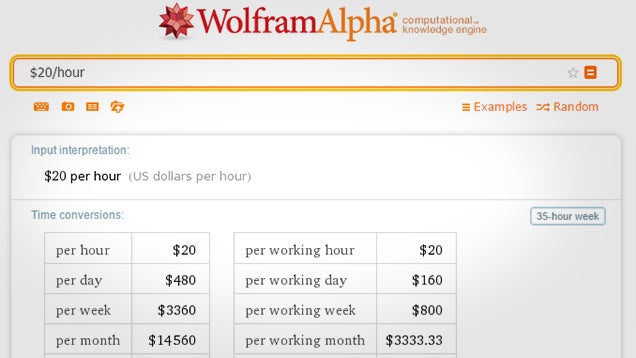
Wolfram Alpha is to Google's answer cards as movies are to paper flip books. Google will tell you everyday things like how many ounces are in a cup. Wolfram Alpha can tell you about median salaries in a given field, or perform key financial calculations. You can even estimate your blood alcohol content. The site is excellent at in-depth research and calculations that go beyond web search results.


Google Unit Conversions Become an Interactive, No-Refresh Gadget

If you use Google for on-the-fly measurement conversions, your days of multiple searches are over.…Read more
The Wayback Machine Shows You the Internet of the Past


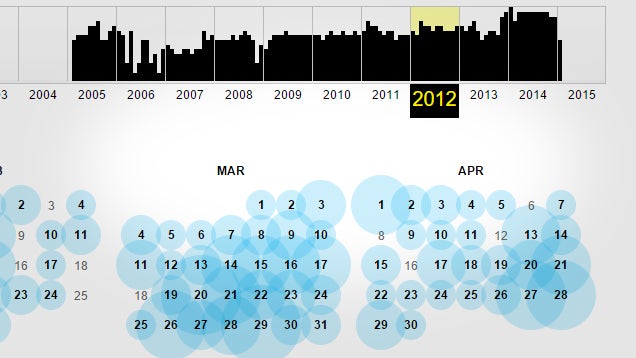
The internet is constantly changing and what you're looking for may have either been removed or changed. Archive.org is a non-profit organization that keeps track of public domain movies, audio and text. One of its most useful tools, though, is the Wayback Machine. It crawls websites and saves a snapshot of the sites it visits. You can view any site in its archive as it appeared in the past. It's not completely comprehensive (an almost impossible task), but you can view years worth of history for major sites.
Topsy Analyzes Twitter's Real-Time Data Stream


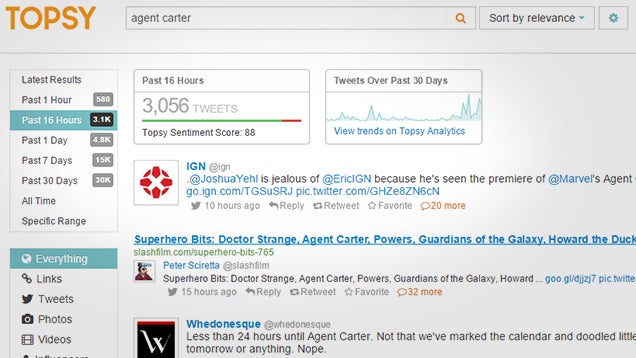
Twitter encourages real-time sharing, which means it's uniquely positioned to share information on current events. It's also incredibly dense and difficult to sift through. Topsy makes it easier. It can filter by time range, collects videos, photos, or links, and even analyzes sentiment. It can even determine which accounts have the most influence on a topic. If you're trying to get the hang of a breaking news story, Topsy can give you something of a bird's eye view.
Use Forums to Get Answers From Real People1

Not every question has a simple, direct answer. If your problem is too specific and obscure, or if you need personal advice and experience, forums are an excellent place to get unfiltered input from human beings. With forums, you tend to have two options: general sites that have answers for just about everything, or specialty forums that tend to attract like-minded experts in the field you're looking for. Here are some of the best resources to start your search with.
Reddit Hosts Virtually Limitless Sub-Communities


To the average person, Reddit is a place where people post funny pictures, share links to current events, and occasionally interview famous people. However, users can create subreddits that focus on whatever they want. Sub-forums already exist for topics including personal finance, relationships and sex, science, and plenty others—and they're not very easy to find on Google. Reddit can even help you find useful subreddits. So, if you want to crowdsource an opinion, heading to Reddit and using their search function can turn up a lot you wouldn't otherwise find.
StackExchange Answers Your Questions Categorically


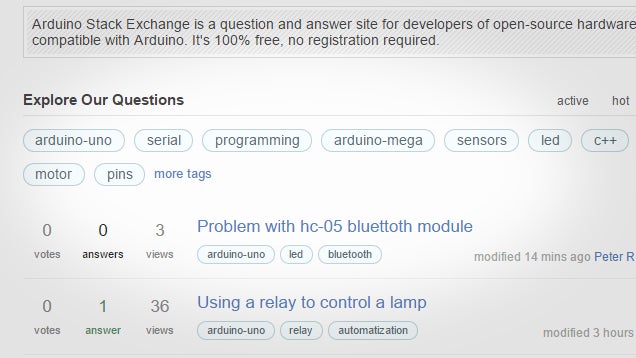
Much like Reddit, StackExchange has sub-communities devoted to particular topics frombicycles to beer. Unlike Reddit, however, it's specifically centered around asking and answering questions (as opposed to sharing news or funny pictures). The sub-sections also aren't user-created, so there aren't quite as many as Reddit, but the site does focus on curating professional, high-quality responses. If you can't find an answer to a question you're looking for, or you simply want to get answers from people who know what they're talking about, this is a great place to start. Of course, start by searching for your question in case someone else has already asked it.
Enthusiast Forums Bring Experts Together


If you're not getting the answer you need (or you just want to dive deeper), enthusiast forums are an excellent resource. Not only do they bring together some of the most interested people on a given topic, but they create massive archives of discussions that you can search through to find answers to questions that only one other person asked several years ago.

There are nearly as many forums on the internet as people, but here are some of the most useful and active ones for various topics:
  • XDA (Android and Windows Phone): XDA is an excellent resource for people who want to root their phones, troubleshoot problems, or find new and interesting apps. It's not only Android phones, either. You can find information for Windows Phone and even some iOS posts.
  • SlickDeals (Deals and Personal Finance: SlickDeals forums are useful getting information on credit card interest rates, career discussions, and tips on how to find your own deals. It's not all coupon alerts, so if you haven't dived in, take a look.
  • BodyBuilding.com (Fitness and Exercise): Accountability is essential for getting in shape or learning to eat well. Bodybuilding.com is one of the largest forums for health and fitness around (and in fact one of the largest on the internet in general).
These are just a few, but there are tons of others for nearly every topic imaginable. From anime to music, architecture to aviation. Many forums can be dense, but don't be put off by walls of text. Use built in search options, or if the site doesn't have great search tools, you can at least use the site: operator on Google itself.
Learn the Fine Art of Finding Quality Sources
Google often spoils us by giving us exactly what we're looking for (assuming we ask the right question) in the top few search results. However, just because something is the top result doesn't mean it's right. Whether you're using Google or other resources, there are a few helpful rules that can help you get the right information you need.


How to Determine If A Controversial Statement Is Scientifically True

Every day, we're confronted with claims that others present as fact. Some are easily debunked, …Read more
Always Read the Comments
When you're reading political news, most people would tell you not to read comments. If you're trying to get relationship advice or figure out how to set up a retirement account, opposing viewpoints are essential. Even here at Lifehacker, we know that some of the best tips come from readers, which is why we place a big focus on the comments, promoting the best ones up at the top.

Many of the resources we've listed above also have voting systems. This can help you discern whose advice the community agrees with, even if they don't state it outright. Of course, you should always take this into the context of the community itself. Often, different communities will upvote different perspectives based on where you ask. However, if a seemingly persuasive post has received a lot of negative attention, it might be worth finding another source. This is particularly useful in low-traffic threads like obscure computer problems.
Investigate the Source of Information
Being persuasive and being correct are not always the same thing. For example, inaccurate scientific "facts" can spread very easily because the people who repeat it don't know any better. Before you accept that something you've read is true, investigate it. When you're on forums, checking the profile of the person making a claim can be a decent first step. Check their sources (if they even list them). Find out who the person is giving you advice. If an accountant has suggestions on dealing with credit card debt, that's okay. But if you're getting information on whale biology from a fireman, it may be worth hunting down more authoritative sources.


How to Conduct Scientific Research On the Internet (Without Getting Duped)

You know how to tell if something controversial is actually true, but what if you want to read up…Read more
Don't Be Afraid to Ask (Politely)
When you were in school, you could ask your teacher to explain something if you didn't understand it. Unfortunately, pre-written guides can't offer the same flexibility. However, a lot of people on the internet will still be willing to help you out if you ask nicely. As we mentioned earlier, sites like StackExchange are specifically geared towards this, but anywhere that people talk to each other is a candidate. For example, Lifehacker sub-blog Hackerspace runs a weekly open thread where readers can ask each other questions about any topic. Frequent commenter Moon got advice on TV that was on sale. Often, you'll come across someone who knows off hand something that would take hours for you to find yourself.
Posted by James Jones at 11:06 AM 0 comments
Email ThisBlogThis!Share to XShare to FacebookShare to Pinterest
Topics: Digital Literacy, ICT Research, James Jones, Soft Skills, STEM Education, Teaching and Learning

Monday, December 8, 2014

$2.725m CCC Grant Opportunity for Coding and Soft Skills!


In support of the White House Information Technology (IT) Initiative aimed at giving more American workers the skills they need to successfully compete for high-paying IT jobs and diversify the pipeline for IT talent, the Division of Workforce and Economic Development Division of the California Community Colleges is pleased to announce $2.725M in available grant opportunities as part of its InnovationMaker grant series. This competitive grant opportunity will build community college capacity to respond to the acute industry need for software coding and programming skills as well as workplace “soft” skills.

“Employers across California have voiced significant frustration that there are inadequate or undependable talent pools in these fields,” said Van Ton-Quinlivan, Vice Chancellor of Workforce and Economic Development at the Chancellor’s Office. “Given the vital role community colleges play in our regional economies, InnovationMaker grants aim to improve training efforts that can reliably deliver on the skill sets needed by employers to hire and create more jobs.” All colleges and districts are eligible to apply.

2014-15 Request for Applications
Industry-Driven Regional Collaboratives --
Acute Need for Coding/Programming Bootcamp and Embedded Soft Skills (14-326) Grant

It is the intent of the Legislature that industry-driven regional collaboratives (IDRC) perform services as participants of regional networks. IDRC provide a stable and flexible response mechanism for the identification of training priorities and to focus resources on intensive projects for competitive and new and emerging industry sector technologies.

In addition to standard individual IDRC applications, this IDRC RFA seeks multi-college proposals for meeting the following acute labor needs:
  • A bundled sequence of short certificates approach to developing software coding/programming skills that would enable the students/participants to enter into and compete for jobs in the broad occupational ladder of data science, user interface (UI) visualization, and/or the multitude of programming languages much in demand by employers. 
  • An approach to embedding employer-advised soft skills into existing CTE curriculum/programs, including work-based learning coursework, in order to answer the pervasive call by employers to improve these competencies amongst graduates. The proposal must have a mechanism for the employer to evaluate/badge demonstrated soft skill competencies. 
Funding shall not be limited per project, but shall be based on the merit and reasonable cost for the anticipated outcomes and performance of the project. Employer match is required.

Letters of Interest must be completed and submitted electronically by Monday, December 22, 2014.

Application materials and more information can be found here..

More on the Chancellor’s Office work to improve California’s workforce skills can be found at DoingWhatMATTERs.cccco.edu.

Regards,
Van Ton-Quinlivan, Vice Chancellor
Workforce & Economic Development Division
Chancellor’s Office, California Community Colleges


Follow me on Twitter @WorkforceVan.

Find Jobs & Economy tips at http://doingwhatmatters.cccco.edu/.

Posted by James Jones at 9:50 AM 0 comments
Email ThisBlogThis!Share to XShare to FacebookShare to Pinterest
Topics: Computer Science, Grants, James Jones, Soft Skills, Workforce Development

Friday, July 25, 2014

RHT: Hardest IT Skills to Find? Soft Skills


by John Reed
July 24, 2014  Robert Half Technology


Developing your soft skills is as important as keeping your tech skills current.
I recently had the opportunity to participate in the Microsoft Worldwide Partner Conference in Washington, D.C.
The event was a great way to catch a glimpse of the future of technology from a tech giant’s perspective, while talking to technology leaders from across the globe.

As I talked to different individuals in the tech community, there was a central theme that continued to resonate around the types of team members they want to hire, but struggle to find: Soft skills are the clear differentiator among tech candidates.

Having the right technical skills are obviously important to do the job, but increasingly the sentiment I’m hearing at gatherings like this one is, “I can teach tech skills, but not soft skills.”

Employers are looking for the whole package. Here are some of the most common soft skills that IT leaders are seeking in their next hires:
  • Communication: The ability to communicate to non-technical people in the organization, understand the business needs and deliver that feedback clearly to the IT team.
  • Problem-solving: The ability to understand complex business issues and solve them through technology.
  • Collaboration: The ability to leverage the strengths and unique perspectives of others within the organization, and work together toward an agreed-upon solution.
  • Team-oriented: The ability to work effectively and thrive as a member of various work groups to bring greater value to the overall organization.
  • Creativity: The ability to find new and innovative approaches to performing the business at hand.
Again, it’s not that demand for tech skills is diminishing — quite the opposite, in fact. But tech skills don’t stand alone in the new world order. Organizations covet team members who bring a strong balance of technical and soft skills to create innovative teams that give them a competitive advantage in the marketplace.

As always, I want to hear your perspective and feedback on this topic in the comments section below.

Thank you.


— John Reed

John Reed is the senior executive director of Robert Half Technology. He can usually be found racking up frequent flyer miles each week traveling to RHT offices across North America and speaking to industry groups about technology hiring trends. When he’s not on the go, he serves as an armchair quarterback for the Oklahoma Sooners. Follow him on Twitter @JReedRHT.
Posted by James Jones at 11:53 AM 0 comments
Email ThisBlogThis!Share to XShare to FacebookShare to Pinterest
Topics: ICT Education, ICT pathways, James Jones, Soft Skills, STEM Education, Workforce Development

Friday, May 16, 2014

RHT: Have Soft Skills Bypassed Tech Skills in Importance?

Robert Half Technology

by John Reed
May 15, 2014


Managers are placing increasing weight on a candidate’s soft skills.
Unemployment in the technology industry is between 3 and 4 percent, and organizations continue to feel the strain of identifying and attracting their next generation of employees.
With that said, there appears to be a growing trend by hiring managers placing a premium on the soft skills of a potential employee — and even prioritizing them over technical skills.

In my travels across North America, I continue to hear from IT leaders that while technical skills are important, they can be developed through training. However, soft skills are much more difficult to develop, and in the opinion of many out there, you either have them or you don’t.

What do I mean by soft skills? Employers in large numbers are seeking employees with these attributes:
  • Communication: IT workers with the ability to communicate effectively both verbally and in writing.
  • Problem Solving: IT workers with the ability to look at complicated business issues and bring creative solutions to the table.
  • Customer Service: IT workers who can empathize with their customers and genuinely want to help resolve their concerns.
  • Collaboration: IT workers who can break out of traditional silos and cross-organizational boundaries to collaborate on complex business issues.
Why are soft skills becoming more relevant? Business leaders have fully embraced the value of technology initiatives and the competitive advantage they bring to their organizations. Therefore, more and more technology initiatives are receiving the funding and green light to launch.

Along with increased technology initiatives, there is associated pressure to deliver a high quality technology solution that broadly meets the needs of the organization, and that is dependent on communication and collaboration partnership between IT and the business groups.

We don’t see this premium on soft skills diminishing anytime soon and would appreciate your perspective and comments on the importance of soft skills below. Thank you.


— John Reed

John Reed is the senior executive director of Robert Half Technology. He can usually be found racking up frequent flyer miles each week traveling to RHT offices across North America and speaking to industry groups about technology hiring trends. When he’s not on the go, he serves as an armchair quarterback for the Oklahoma Sooners. Follow him on Twitter @JReedRHT.
Posted by James Jones at 8:51 AM 0 comments
Email ThisBlogThis!Share to XShare to FacebookShare to Pinterest
Topics: ICT Education, ICT Jobs, James Jones, Soft Skills

Tuesday, March 25, 2014

CA Career Briefs - Practice Presenting

CA Career Briefs


“Preparation is the magic bullet to public speaking success. ”

- Ruth Sherman, Presentation Coach

Practice Presenting

Did you know?

In today’s workplace, poor presentation skills can have serious career repercussions. As more and more work becomes teamwork, what a person knows isn’t nearly as important as how well he/she can communicate it. Consequently, employers are looking to hire and advance employees who are good communicators. That includes the ability to make effective presentations. Since oral communication and presentation skills transcend disciplines, a class presentation is an appropriate assignment in almost any course. In doing a presentation, students have an opportunity to prepare, practice and improve a skill that may prove key to their workplace success. The ideas in this activity will give students some general guidelines that should put them more at ease at the podium.

Do this…
  • Ask students questions about class presentations.
  • How many class presentations have you done this semester?
  • Are you comfortable making presentations?
  • Why are good presentation skills important in the workplace?
  • View Public Speaking Tips video.
  • Distribute the Student Activity, review the directions and complete.
  • Share responses.
  • Add an Experience!
To follow up, locate a Toastmasters International Club in your area. Consider giving students extra credit for attending a meeting and then reporting back to the class on their experience. For more practical tips on preparing and delivering a presentation, watch this video.
Posted by James Jones at 11:44 AM 0 comments
Email ThisBlogThis!Share to XShare to FacebookShare to Pinterest
Topics: ICT Education, James Jones, Soft Skills, Teaching and Learning

Tuesday, February 25, 2014

RHT: 5 Tips for Choosing the Best Entry-Level Programming Jobs

by Clea Badion   Robert Half Technology
February 21, 2014


Starting pay isn’t the only thing to consider when choosing your first programming job.

If you’re a programmer at the beginning of your career – whether you’ve just graduated or are about to graduate – you know your skills are in strong demand.
Many firms are seeking skilled programmers, and if you are an expert in one of the most popular programming languages (Java or C++, for example), you’re likely to have some great job options.

But it’s important to be strategic about your initial career choices. A recent article by Robert Half Technology’s senior executive director, John Reed, offers excellent tips on assessing entry-level programming jobs.

Reed points out that while starting pay is important, don’t forget to consider the entire package offered, as well as the skills you’ll have the chance to develop at a firm. Check out the full article below to see all of his tips for choosing the best entry-level programming job.

You have the skills and passion, and you’re raring to make your mark. From well-established corporations to newly minted startups, it seems like everyone wants — and needs — a skilled programmer on staff. And if your credentials are strong enough, you may have your pick of positions. Here are five tips for assessing entry-level programming jobs to help ensure you choose the one that’s right for you:

1. Look at the money. Depending on the employer, the starting salary for entry-level programming jobs varies dramatically from one opportunity to another. It may be fairly low, especially if your first gig is with a startup, or it could approach six figures if you sign with a large, established company and you have in-demand skills. To gauge whether the offer is reasonable and in line with industry standards, check out the Robert Half Technology 2014 Salary Guide.

2. Look at the money potential. Even if the starting salary is on the low side, it may not stay that way for long, especially if you’re good. Assess the bigger picture and don’t let your immediate financial needs cloud your long-term aspirations. When weighing the compensation of various entry level programming jobs, ask questions about bonus potential, stock and whether the company offers regular salary increases.

3. Look at the whole package. Present and future wages are just one part of the equation when it comes to evaluating programming jobs. A good benefits package orcool perks can help make up for a less-than-stellar salary. Also consider how the job fits with your lifestyle, current needs, long-term goals and work/life balance. For example, if you value flexibility, look for an employer that allows telecommuting.

4. Look at where you want to go. Remember, this is just your first gig. Entry-level programming jobs provide a foot in the door and valuable work experience, but it’s crucial to keep long-term career goals in sight. When weighing programming jobs, consider aspects like who you might work with and learn from, what doors an opportunity may open down the line, and whether you get to be part of a cool project or up-and-coming technology.

5. Look at adding to your tool kit. During the interview, ask the hiring manager about the company’s policies for training and career advancement. This can help you decide whether it makes sense to accept the offer. Almost seven in 10 IT workers surveyed in arecent Robert Half Technology survey said the ability to acquire a new skill is important when evaluating job opportunities.

Being part of a large development team could help you hone your skills by allowing you to learn from more experienced programmers. On the flipside, if you’d rather gain a broad range of experiences, joining a smaller organization could allow you to grow in areas like client relations and project management. It also can provide you with a quicker route to leadership positions.

Having a clear sense of what you want from your career is key to choosing the first programming jobs that are right for you. Figure out your immediate priorities — rent, paying off student loans and so on — and long-term goals. When researching specific jobs, try to connect with programmers who have worked with the organization you would like to join; their insights can be valuable. Then, decide which one will best take you where you want to go, and take the plunge!

About Robert Half Technology

With more than 100 locations worldwide, Robert Half Technology is a leading provider of technology professionals for initiatives ranging from web development and multiplatform systems integration to network security and technical support. Robert Half Technology offers online job search services at www.rht.com. Follow Robert Half Technology on Twitter at www.twitter.com/RobertHalfTech.


— Clea Badion

Clea Badion is an editor for the RHT Blog. She’s been writing about the workplace, career trends and technology for the past decade. Clea has 15 years of professional writing and editing experience and a master’s degree in visual studies. She’s a little obsessed with cute animal videos and the show ”American Ninja Warrior.” Follow her on Twitter @cleabadion.
Posted by James Jones at 4:31 PM 0 comments
Email ThisBlogThis!Share to XShare to FacebookShare to Pinterest
Topics: Computer Science, ICT Jobs, James Jones, Soft Skills, Workforce Development

Monday, February 10, 2014

RHT: Starting Software Developer Salary Increasing in 2014

by Clea Badion  Robert Half Technology
February 10, 2014


Starting compensation for software developers will increase in 2014.

Similar to other hot IT positions such as software engineers andmobile app developers, software developers are hot in the job market.

“Software developers are the most in demand position in Nashville,” said Eric South, Robert Half Technology’s Nashville branch manager.

He added that because many major company initiatives are now web based and understaffed, “We’re seeing very high demand in the healthcare space, specifically around EHR/EMR requirements, ICD-10 and meaningful-use deadlines.”

Demand in Nashville is echoed across the country: Software developers grabbed the No. 1 spot inU.S. News & World Report’s survey of best jobs of 2014, based on the profession’s excellent prospects for growth.

Starting Software Developer Salary: Going Up

It’s not surprising given the demand for these IT professionals that a starting software developer salary is projected to increase 7.7 percent in 2014, with compensation ranging from $80,250-127,250*. (You can use our Salary Calculator to adjust an entry-level software developer salary for your city.)
What’s it Take? Software Developer Job Description

If you’re wondering what skills you need to become a software developer, here’s a list of qualifications:
  • Must be detail-oriented and have excellent problem-solving and analytical abilities.
  • Requires strong communication skills and the ability to work independently and as part of a development team.
  • Possess a bachelor’s degree in computer science or related field, but hiring managers may accept a two-year technical degree if combined with several years of practical experience.
  • Must have programming skills in languages and frameworks such as C#/C++, HTML, Java/Java Enterprise Edition, Microsoft .NET and SQL Server.
  • Two to three years of programming experience is required, and complex projects may require additional experience.
A typical software engineer job description includes:
  • Coding, testing and debugging programs according to computer engineering specifications
  • Modifying, expanding and updating applications
  • Communicating with a team that includes analysts, engineers and quality assurance testers in order to coordinate and document application development and testing
  • Developing software prototypes
Soft Skills Also Key for Software Developers

South added that knowledge of Scrum/Agile will give candidates an advantage, as will non-technical skills such as communication skills and an entrepreneurial mindset.

When crafting your software developer resume, South says to be sure to include specific project details, timelines, successes and most the recent technologies you used.

For recent IT graduates interested in breaking into this field, South has some advice: “Start building applications and working on projects while you’re still in college. Pick a direction you want to go and become an expert (.NET, Java, SQL, etc.),” said South. “And give me a call!”

In addition to information on a starting software developer salary and a software developer job description, you’ll find information on starting compensation for 70 IT jobs in 150 North American cities in our 2014 Salary Guide.

*In Canada, a starting software developer salary is projected to increase 7.6 percent, ranging from $68,000-$113,500.


— Clea Badion

Clea Badion is an editor for the RHT Blog. She’s been writing about the workplace, career trends and technology for the past decade. Clea has 15 years of professional writing and editing experience and a master’s degree in visual studies. She’s a little obsessed with cute animal videos and the show ”American Ninja Warrior.” Follow her on Twitter @cleabadion.
Posted by James Jones at 2:09 PM 0 comments
Email ThisBlogThis!Share to XShare to FacebookShare to Pinterest
Topics: Computer Science, ICT Education, ICT Jobs, ICT Research, James Jones, Soft Skills, Software Assurance

Friday, January 31, 2014

RHT: 8 Things IT Recruiters Wish They Could Tell You


by Clea Badion
January 30, 2014 Robert Half Technology


If there were no filters, here’s what IT recruiters would say to candidates.

For many highly skilled IT professionals — systems administrator, web developer or software engineer, to name a few — it’s probably not news to you that you’re in demand. In fact, you may even be hearing on a regular basis from firms interested in hiring you.

But just because you hold many of the cards in the IT job market, doesn’t mean you can do no wrong when talking to recruiters or hiring managers. No matter what city or town you live in, the tech community tends to be a small one, and you always want an active professional network so you have options if a time comes when you want to make a move.

I talked to four different Robert Half Technology recruiters (who will remain nameless!) and asked them, “If there is one piece of advice you could anonymously share with candidates, what would it be?” Here are eight things they’d tell you:
  1. Have realistic salary expectations. “There are limits, even in a hot market, and you can price yourself out of a job,” said one recruiter. Experienced recruiters know their market and what cost they will bear. Do your own salary research, but also trust their expertise. And don’t forget to consider all aspects of a job offer: Will you get opportunities to learn at a company that you wouldn’t somewhere else, or does the firm offer great perks? 
  2. Give your current employer a chance. Before you approach a recruiter, be clear about what’s not working in your current job and see if you can change it. One recruiter I spoke to said, “A lot of candidates come to me and want a raise, but they haven’t had a conversation with their current company yet.” Most employers want a chance to fix an issue with a valued employee. If they don t fix it, then it might be time to look. 
  3. Pay attention to appearances. Don’t give a hiring manager an excuse not to hire you. “Sometimes candidates don’t present themselves as well as they could,” said a recruiter. “While it seems basic, make sure you take a shower and comb your hair before an interview.” He added that any strong scent – from smoking or perfume, for example – can work against you in an interview. And while you probably don’t need to wear a suit and tie if you’re applying for a regular programming job, if you’ll be interacting with C-level executives, you’ll need to dress appropriately. Let interviewers focus on your skills, not your personal appearance. 
  4. Be professional when you answer the phone. “It’s surprising how many candidates are abrupt, unprofessional or even rude when they answer the phone,” said a recruiter. You don’t know who will be calling you, whether it’s a recruiter or hiring manager, so always be polite and professional when you answer the phone. If you can’t talk right then, give the caller a better time to reach you. Also, be sure that your voicemail message is at least somewhat professional. 
  5. Don’t post your resume on every job board. When you’re searching for a job, be selective. In addition, pick a recruiter you like and stick with him or her. “If you’ve signed up with every recruiter in the area, it makes it less likely that I’ll want to work with you,” said a recruiter. That said, if you aren’t getting interviews or the chemistry isn’t right, don’t hesitate to find someone else. 
  6. Be transparent. If a recruiter is working hard to place you, but you’ve already received a job offer at another firm, tell the recruiter you’re working with. “We need to know where you are in the job search process so we’re not trying to place someone who is unavailable,” said a recruiter. Also key: Let recruiters know if you have a vacation coming up that might affect an interview time or start date for a job, so they can convey it to hiring managers. 
  7. Bring your “A” game. Hiring managers are seeking IT professionals who are truly interested in a job. Show enthusiasm in an interview, even if you’re shy or reserved by nature. Ask questions about the technology and company culture during an interview, for example. A recruiter I spoke to said, “Showing up for an interview doesn’t necessarily mean you want the job – you have to demonstrate your interest.” Check out these interview mistakes for more tips. 
  8. Don’t burn bridges. You never know when you’ll need a job: “People in tech talk, and if you’re dishonest or unprofessional with one hiring manger, other hiring managers will likely hear about it,” said a recruiter. 

Indeed. On that last note, always treat everyone you encounter in a job search with courtesy and professionalism. You never know when you’ll run into them again.

And, while your technical skills are essential, so are your interpersonal skills, and you’re demonstrating them at every stage of a job search. Leave your tips for the job hunt in the comments section.


— Clea Badion

Clea Badion is an editor for the RHT Blog. She’s been writing about the workplace, career trends and technology for the past decade. Clea has 15 years of professional writing and editing experience and a master’s degree in visual studies. She’s a little obsessed with cute animal videos and the show ”American Ninja Warrior.” Follow her on Twitter @cleabadion.
Posted by James Jones at 10:41 AM 0 comments
Email ThisBlogThis!Share to XShare to FacebookShare to Pinterest
Topics: ICT Education, ICT Jobs, Internships, James Jones, Soft Skills, Workforce Development

Tuesday, October 29, 2013

CA Career Briefs: Manage Emotions


Workplace Skills
California Career Briefs      
“It is very important to understand that emotional intelligence is not the opposite of intelligence, it is not the triumph of heart over head — it is the unique intersection of both.”
                             - David Caruso, PhD, Co-founder EI Skills Group
 

Manage Emotions

Did you know?

Emotionally intelligent employees are more productive, more likely to meet goals, and have greater rates of retention. While “technical skills’ are essential, in today’s workplace “relationship skills” are the new currency. Employees must not only know what to do (the task), but how (through relationships) to do it. Emotional Intelligence (EI) is defined as one’s ability to understand and effectively manage one’s own emotions as well as a capacity to understand the emotions, needs, and concerns of others. Today’s activity will introduce students to an EI vocabulary.

Do this…

  • Ask students a few questions. Find out what they already know about EQ.
What does IQ stand for? (Intelligence Quotient)What does EQ stand for? (Emotional Quotient)Why would EQ be important to employers? (Those with high EQ are more productive, effective, and successful.)
  • View video.
  • Review some of the important information in the video clip.
What are the four areas of EI?What happens in schools that have EI programs?What happens to a person’s EI as he/she grows and develops?
  • Distribute the Student Activity, review directions and complete.
  • Review and discuss the correct answers:
    1,k; 2,f; 3,e; 4,d; 5,g; 6,b; 7,h; 8,a; 9,o; 10,m; 11,j; 12,i; 13,l; 14,n; 15,c

Get Real!

Have students identify 1 or 2 traits they would like to work on for a week and report back the outcome.  For more on EI building strategies, Google offers this innovative approach to inspire their workforce.
Posted by James Jones at 12:41 PM 0 comments
Email ThisBlogThis!Share to XShare to FacebookShare to Pinterest
Topics: ICT Education, James Jones, Soft Skills, Workforce Development

Tuesday, October 15, 2013

CA Career Cafe: Join a Professional Association

CA Career Café

"The way of the world is meeting people through other people.”

  • Robert Kerrigan

Did you know?

Joining a Professional Association while still on campus can help students learn about their prospective career paths and offer a wealth of experiential and networking opportunities. Professional organizations exist for almost every profession from artists to zoo keepers. These non-profit organizations host meetings, conventions, and virtual workshops. Introduce your students to Professional Associations via the California Career Café where students can access Cool Connections, a Professional Association database.

Try this…

  • Ask your students about Professional Associations…
What is a Professional Association?
Can you name some Professional Associations?
Why join a Professional Association?
  • Share your own Professional Association experiences.
  • View video.
  • Access this Professional Association database and identify associations related to your discipline.
  • Distribute the Student Activity, review the directions, and complete.
  • Discuss the possibilities and power of networking cards.

Add an Experience!

Have students try the Connect to a Professional Association student lesson on CaCareerCafe.com. Encourage students to make a personal connection via phone, email or in person using their networking card as part of their introduction.
Posted by James Jones at 12:29 PM 0 comments
Email ThisBlogThis!Share to XShare to FacebookShare to Pinterest
Topics: Computer Science, Digital Media, Entrepreneur, ICT Education, ICT Jobs, ICT pathways, James Jones, Networking, Security, Soft Skills, Software Engineering, Workforce Development

Wednesday, September 18, 2013

California Workforce Association: From Jail to Jobs Workshop

 
REGISTER TODAY SPACE IS LIMITED

The Jails to Jobs training is packed with practical and proven approaches to job search that will help close the employment gap for re-entry candidates. You will also get an opportunity to network with other employment program staff and learn their best practices! Find out how to close the employment gap and help them put the criminal justice system behind them!  


REGISTER TODAY!
916.325.1610| 916.325.1618|
info@calworkforce.org | Website

Copyright © 2013. All Rights Reserved. 
Posted by James Jones at 1:14 PM 0 comments
Email ThisBlogThis!Share to XShare to FacebookShare to Pinterest
Topics: ICT Education, ICT Jobs, James Jones, Soft Skills, Workforce Development

Tuesday, September 17, 2013

California Career Briefs: Get Soft Skills

CA Career Briefs

“No matter how smart they are, or how many degrees they earn, students need a solid set of soft skills in order to be successful.”

- Nancy Barry, Author and Speaker Get Soft Skills

Did you know?

Employers seek employees who have a positive attitude, strong work ethic, excellent communication skills and business etiquette savvy. They want new hires who are passionate about their work, see everything as an opportunity, and meet deadlines. These skills are dubbed soft skills and are not typically taught in a college course. Yet, studies suggest that hard skills contribute to only 15% of a person’s workplace success while the remaining 85% relies on good soft skills. Give your students an edge over the competition by helping them define and develop their soft skills.

Do this…

  • Ask students to help you define soft and hard skills.
List some of their hard skills. (do calculus, speak French…)List some of their soft skills. (effective speaker, great collaborator…)
  • View video.
  • Distribute the Student Activity, review directions and complete.
  • Share some students’ responses to…would you hire you?

Get Real!

For several more free and collaborative soft skills lessons try Backpack to Briefcase and the Workplace Skills archive on CACareerBriefs.com. For soft skills lessons students can complete indepedently, steer them to Get Job Ready on CACareerCafe.Com.
Posted by James Jones at 11:44 AM 0 comments
Email ThisBlogThis!Share to XShare to FacebookShare to Pinterest
Topics: James Jones, Soft Skills, STEM Education, Teaching and Learning

Tuesday, June 4, 2013

Free San Francisco Faculty Development in San Francisco, June 17-21!

It is not tool late to join us for the outstanding FREE faculty development event in San Francisco, June 17-21, for which qualified community college faculty in ICT related programs in California, Nevada, Hawaii or the Pacific Territories may receive stipends or travel expense reimbursements, courtesy of the National Science Foundation and the CCC Chancellor's office.  105 of your peers have registered so far.

The southern California Faculty Development Week is currently underway, with roughly 100 instructors in attendance. 

ICT is fast moving and hard to keep up with.  These tracks offer opportunities to gain valuable new knowledge and skills in developing the ICT workforce.

Click on event links below for full event and track descriptions.

This week's focus:
  • Learn storage technologies from market mover Netapp in this first time offering for community college ICT educators in the MPICT region in San Francisco
  • Learn how to integrate problem-based learning into ICT classes in San Francisco
June 17-21, 2013 at the City College of San Francisco Mission Campus

Cable Car 

Six "Train the trainer" tracks to prepare faculty to teach new or improve existing courses or programs:
  1. Cisco IT-Essentials (Also Available to High School Teachers)
  2. Cisco CCNA 1 Version 5 (Also Available to High School Teachers) - Class Full
  3. Accelerated NetApp Certified Storage Associate (NCSA) Boot Camp (See video interview for why to attend)
  4. Content Management Systems (CMS) Fundamentals and Security
  5. User Experience and Interaction Design Intensive
  6. Packet Analysis and Intrusion Detection - Class Full
One pedagogical track to impart new teaching and learning skills: 
  1. Teach Your Students to Think for Themselves with Problem-based Learning (and Make Employers Happy)
Learn more about it and register! 

We may not be able to support these kinds of great events forever.  Take advantage of it!  We hope to see you in San Francisco soon.   

Thanks,

James Jones
Executive Director
MPICT
Posted by James Jones at 10:38 AM 0 comments
Email ThisBlogThis!Share to XShare to FacebookShare to Pinterest
Topics: Digital Media, ICT Education, James Jones, Soft Skills, Teaching and Learning, Workforce Development

Thursday, May 9, 2013

Center for Professional Excellence: 2013 Professionalism Study

This issue is a big deal to ICT workforce employers.

Center for Professional Excellence

Professionalism Still a Problem in Workplace

There are glimmers of hope that professionalism among entry-level employees is making short-term gains, but, in the long-term, a sizeable percentage of respondents believe that professionalism has decreased over the past five years. That’s according to the 2013 Professionalism In The Workplace Study, annual nationwide survey on the state of professionalism, an annual nationwide survey from the Center for Professional Excellence (CPE) at York College of Pennsylvania. 

As in the past three years, researchers asked HR professionals to comment on the state of professionalism. This year, researchers also reached out to a nationwide sample of managers and supervisors. 

“HR professionals are more likely to report problems of professionalism in the workplace than are managers,” said Matthew Randall, executive director of the CPE. “However, when managers specified the employee segments that most lack professionalism, they point toward younger employees.”

Researchers compared data from the past four years and found an apparent generation gap between hiring managers and HR professionals and younger, entry-level employees.

“Much of the generation gap revolves around professionalism standards,” said David Polk, PhD, whose firm, the Polk-Lepson Research Group, was commissioned to conduct the survey. “Current business leaders and HR professionals do not believe that the definition of professionalism should change over time. Business and HR professionals say young employees need to learn to conform to ‘current standards’ of professionalism rather than the standards be modified in response to larger society changes.” 

 Entitlement Among New Employees

Every year this survey has asked HR respondents if younger employees feel a sense of entitlement. The good news, from the company perspective, is that over the past four surveys, the sense of entitlement has slowly decreased, according to HR professionals. In 2009, 60% of respondents said that entitlement among younger employees had increased.  In 2010, that number fell to 55%.  In 2011, that number fell to 50%. The bad news, however, is that it is still a problem. Half of the HR respondents and 33% managers report that a sense of entitlement has increased over the past five years. 

About the Study

A nationwide random sample of 401 human resource professionals was surveyed. Data was collected by using online surveys. The maximum margin of error associated with the samples is 4.9% at the 95% confidence level.

This is the fourth consecutive year that the Center for Professional Excellence at York College of Pennsylvania has conducted a survey on the state of professionalism. The Center plans to capitalize on the research by using the results to guide campus seminars, classroom experiences and student workshops.

Click here to download a copy of the 2013 Professionalism in the Workplace Study.
Click here to download a copy of the 2013 Professionalism on Campus Study.

Click here to download a copy of the 2012 Professionalism in the Workplace Study.
2012 Professionalism in the Workplace Study - Visual Snapshot  
Posted by James Jones at 2:09 PM 0 comments
Email ThisBlogThis!Share to XShare to FacebookShare to Pinterest
Topics: ICT Education, ICT Jobs, James Jones, Soft Skills, Workforce Development
Older Posts Home
Subscribe to: Posts (Atom)

Search This Blog

Topics

AI (1) Apprenticeship (8) Big Data (56) CATV (14) Certifications (56) Cloud (44) Computational Thinking (17) Computer Engineering (33) Computer Science (441) CTE (115) Database (72) Digital Divide (28) Digital Literacy (200) Digital Media (126) Diversity (119) Educational Technology (213) elearning (107) Entrepreneur (8) ethics (133) funding opportunity (14) Gaming (28) GIS (15) Grants (48) Green IT (15) Hacking (124) Healthcare IT (10) ICT Applications (75) ICT Core Competencies (18) ICT Education (1056) ICT Infrastructure (235) ICT Jobs (443) ICT pathways (356) ICT Regulation (177) ICT Research (378) Industry News (795) Innovation (203) Internships (15) IPv6 (10) James Jones (2182) K-12 (71) law (92) Linux (17) math (1) Mobility (95) MOOC (17) MPICT Announcements (105) Multimedia (42) Networking (476) networking security (61) Nevada (2) Olivia Herriford (35) Open Source (25) Operating Systems (49) Pierre Thiry (11) Public Policy (129) recruitment (7) Remediation (1) Rick Graziani (55) Sam Bowne (10) Security (535) Security; Identity Management (202) Smart Grid (6) Social Media (37) Soft Skills (27) Software Assurance (23) Software Engineering (37) STEM Education (91) Storage (42) Teaching and Learning (267) Telecom (119) Tools (42) virtualization (38) Web (328) WIB (11) Wireless (102) women (45) Women in ICT (38) Workforce Development (377)

Contributors

  • James Jones
  • Mid-Pacific ICT Center
  • Olivia Herriford
  • Percy Ellis
  • Pierre Thiry
  • Rick Graziani
  • Sam Bowne
  • Unknown
  • Unknown
  • singer808

Articles by Contributor

  • James Jones (2182)
  • Olivia Herriford (35)
  • Pierre Thiry (11)
  • Rick Graziani (55)
  • Sam Bowne (10)

Websites

  • Mid-Pacific ICT Center
  • MPICT YouTube Channel
  • MPICT on Facebook
  • National ICT Center
  • BATEC
  • ATETV
  • Cyberwatch
  • Cyberwatch West
  • CSSIA

Subscribe

Posts
Atom
Posts
All Comments
Atom
All Comments

Followers

Theme images by enot-poloskun. Powered by Blogger.