Governor Brown recently signed AB1270 changing the name of the California Workforce Investment Board to the California Workforce Development Board.
On Monday August 3, 2015, the board website address name will change to www.cwdb.ca.gov. Please refresh or clear your browser if the page does not automatically show up. Be sure to update your favorites or bookmarks.

Showing posts with label Industry News. Show all posts
Showing posts with label Industry News. Show all posts
Wednesday, July 29, 2015
Tuesday, July 28, 2015
BBC: WTO strikes 'landmark' IT trade deal
24 July 2015 BBC

Chipmakers like Japan's Renesas will benefit from the deal
The World Trade Organisation (WTO) has struck a "landmark" deal to cut tariffs on $1.3 trn (£838bn) worth of technology products.
The deal will update the 18-year-old IT Agreement and add 200 products to the zero tariff list.
It is expected to give a boost to producers of goods ranging from video games to medical equipment.
The WTO says the sum is equal to global trade in iron, steel, textiles and clothing combined.
"Today's agreement is a landmark," said WTO Director-General Roberto Azevedo.
"Eliminating tariffs on trade of this magnitude will have a huge impact," he continued.
"It will support lower prices - including in many other sectors that use IT products as inputs - it will create jobs and it will help to boost GDP growth around the world."
The final technical details will be worked out until December.
The existing 1996 IT agreement was seen by industry and policy makers as woefully out of date as it did not cover devices and products invented since then.
Products added range from advanced computer chips to GPS devices, medical equipment, printer cartridges and video-game consoles
Technology manufacturers such as General Electric, Intel, Texas Instruments, Microsoft and Nintendo are among the many companies expected to benefit from the deal.
Negotiations on updating the technology agreement began in 2012.
Analysis: Andrew Walker, BBC World Service economics correspondent
Finally, the WTO has brought its Information Technology Agreement (ITA) into the 21st century.
This was the first tariff cutting agreement the WTO has managed since ITA 1.0, as it is not officially known, was agreed.
The key political deal was done in 1996 at a WTO ministerial conference in Singapore. Sadly, you might think, I was there and am still covering the same story, though I have had very little reason to think about this one since.
Still this is an important step, and it is the second one the WTO has taken in two years - a very short period in the geological timescales of trade negotiations.
The other was an agreement on simplifying trade procedures, the one concrete achievement of the negotiations called the Doha Round launched in 2001.
So a significant step towards more liberalised trade has been taken. But the WTO has the rest of the wide ranging and complex Doha Round still to do.
The World Trade Organisation (WTO) has struck a "landmark" deal to cut tariffs on $1.3 trn (£838bn) worth of technology products.
The deal will update the 18-year-old IT Agreement and add 200 products to the zero tariff list.
It is expected to give a boost to producers of goods ranging from video games to medical equipment.
The WTO says the sum is equal to global trade in iron, steel, textiles and clothing combined.
"Today's agreement is a landmark," said WTO Director-General Roberto Azevedo.
"Eliminating tariffs on trade of this magnitude will have a huge impact," he continued.
"It will support lower prices - including in many other sectors that use IT products as inputs - it will create jobs and it will help to boost GDP growth around the world."
The final technical details will be worked out until December.
The existing 1996 IT agreement was seen by industry and policy makers as woefully out of date as it did not cover devices and products invented since then.
Products added range from advanced computer chips to GPS devices, medical equipment, printer cartridges and video-game consoles
Technology manufacturers such as General Electric, Intel, Texas Instruments, Microsoft and Nintendo are among the many companies expected to benefit from the deal.
Negotiations on updating the technology agreement began in 2012.
Analysis: Andrew Walker, BBC World Service economics correspondent
Finally, the WTO has brought its Information Technology Agreement (ITA) into the 21st century.
This was the first tariff cutting agreement the WTO has managed since ITA 1.0, as it is not officially known, was agreed.
The key political deal was done in 1996 at a WTO ministerial conference in Singapore. Sadly, you might think, I was there and am still covering the same story, though I have had very little reason to think about this one since.
Still this is an important step, and it is the second one the WTO has taken in two years - a very short period in the geological timescales of trade negotiations.
The other was an agreement on simplifying trade procedures, the one concrete achievement of the negotiations called the Doha Round launched in 2001.
So a significant step towards more liberalised trade has been taken. But the WTO has the rest of the wide ranging and complex Doha Round still to do.
Tuesday, July 21, 2015
CyberCalifornia Launch

As we have seen in recent news headlines, security breaches can bring entire organizations, states and countries to their knees. In today's connected world, making security a top priority is no longer a choice - it's a must. As public and private organizations continue to operate within this new era of the Internet, security will become critical to maintaining trust with the public, building company reputation, as well as safeguarding data, IP and critical infrastructure.
California is at the center of the digital revolution that is shaping the world around us. Already a national center of commercial cybersecurity activities, California is home to companies building the cybersecurity products and solutions that are securing commercial businesses, academic institutions and governmental organizations across the globe.
In an effort to help advance the goals and promote the accomplishments of the Governor's Cybersecurity Task Force, CyberTECH, among other state and local leaders, recently launch CyberCalifornia.

CyberCalifornia will organize public-private partnerships in cybersecurity, with the goals of facilitating research and innovation in cybersecurity, educating California businesses about cybersecurity needs and resources, and connecting California's robust workforce development system with the needs of California employers.
Led by its Board of Advisors, CyberCalifornia activities include:
Assisting in the organization of private sector advisory groups by vertical industry such as banking and finance, high technology, agriculture, etc.
Assisting in the development and promotion of cybersecurity career pathways
Partnering with local and regional economic development organizations to inform California's small business community about cybersecurity needs and solutions
Establishing connections between the cybersecurity and Internet of Things sectors through activities such as conferences and media events
To learn more about CyberCalifornia, please contact darin@cyberhivesandiego.org.

Darin Andersen, CEO, CyberUnited, Co-Chair, CyberTECH, Co-Chair, Economic Development Subcommittee, California Cybersecurity Task Force
"CyberCalifornia: Cybersecurity and IoT Gold Rush"
Recently, CyberTECH helped launch CyberCalifornia with other State and local leaders. The initiative is organized in conjunction with the Innovative Hub (iHub) Network, a program administered by the State Office of Economic Development and in partnership with Governor Brown's Cybersecurity Task Force.

Jerry Brown, Governor of California
CyberCalifornia will organize public-private partnerships in cybersecurity to better protect California's critical infrastructure, businesses and citizens from cyber threats, facilitate research and innovation in cybersecurity, educate California businesses about cybersecurity needs and resources, and connect California's robust workforce development system with the needs of California employers.
Center of Cybersecurity and Internet of Things Excellence (CCIoTE)
California is home to the personal computer, the firewall, anti-virus and many other cybersecurity products. Today, California companies are at the forefront of new technologies ushering in the Internet of Things (IoT), the term for the phenomenon where people and things are connected to the Internet, leveraging sensors and real time analytics and cloud technologies.
California's leadership role in advanced technology sectors including autonomous vehicles, biotechnology, precision in medicine and advanced manufacturing, will contribute to the State's continued excellence in cybersecurity and privacy. The powerful combination of cyber and the emergence of these innovative intensive sectors make California the perfect place to build secure next generation technologies.
California has a rapidly growing information technology industry cluster and offers the full spectrum of cybersecurity capabilities. Our Golden State has tremendous assets to keep our Country safe, advance innovation with security and privacy built in and be a beacon for other States in our Nation to follow.

Charles "Chuck" Brooks, Vice President, Government Relations and Marketing, Sutherland Global Services
"Adopting a Cooperative Global Cyber Security Framework to Mitigate Cyber Threats (Before it is too Late)"
The recent OPM cyber breach at the U.S. Government's Office of Personnel Management (OPM) provided a wakeup call to the seriousness and sophistication of the cyber security threat aimed at both the public and private sectors. The fact is that over 43% of companies had breaches last year (including mega companies such as Home Depot, JPMorgan, and Target). Moreover, the intrusion threats are not diminishing. For example, British Petroleum (BP) faces 50,000 attempts at cyber intrusion every day.
According to the think tank Center for Strategic and International Studies (CSIS), cyber related crime now costs the global economy about $445 billion every year. These cyber security breaches demonstrate that there is a continued need for protocols and enhanced collaboration between government and industry.
In 2014 code vulnerabilities such as Heartbleed, Shellshock, Wirelurker, POODLE and other open source repositories caused chaos and harm. The cyber security community responded to those vulnerabilities with "react and patch." Unfortunately, this means of response has been for the most part, a cosmetic or band aid approach.
The cyber security community's posture must change to one of wait and react to that of being proactive and holistic. It is not really a question of which policies, processes and technologies are ready and best, that will always be debatable. Being proactive means adopting a working Industry and Government Global Cyber Security Framework that would include measures for encryption, authentication, biometrics, analytics, automated network security, and a whole host of other topics related to cyber threats.
CONTINUE READING

LIFARS, Featured CyberTECH Member
LIFARS is a digital forensics and cybersecurity intelligence firm based in New York City. With its history of investigating cybersecurity breaches across a number of industries, LIFARS is uniquely positioned to help increase cybersecurity posture to protect organizations and individuals from real-life hackers and advanced persistent threat actors. By bringing in LIFARS, you can maximize your existing investment into the cybersecurity infrastructure and make sure that your future investments are strategically placed – delivering maximum protection while preserving the productivity of your employees. For these and other reasons, LIFARS was recently ranked as the #2 cybersecurity company in New York Metro area on the Cybersecurity 500 list.
LIFARS WEBSITE
In addition to providing robust security solutions based on best practices and personal hands-on experiences, LIFARS continuously explores the latest innovations in the cybersecurity field and always seeks to find what is shaping tomorrow's industry landscape. In a recent interview with Founder and CTO of LIFARS, Ondrej Krehel, and LIFARS' Digital Forensic Examiner, Paul Kubler, they discussed strategies and policies for cybersecurity in the world today, including common mistakes and how to make them right.
LIFARS INTERVIEW

NXT Robotics is a San Diego-based company that designs and builds service robots to support the increasing needs of the hospitality industry. NXT Robotics' service robot platforms are able to provide delivery, security and guest-related services to customers - all while maintaining a consistent and high degree of quality.
The company's founder, Jeff Debrosse has over 20 years of software engineering, cybersecurity R&D and enterprise product management and deployment experience. "This is an exciting time for NXT Robotics," said Jeff. "With access to the CyberTECH community and its resources, our success is further guaranteed."
The company will be providing CyberTECH's incubator and shared workspace offices, CyberHive and iHive, with its own Nixie. "Your team, tenants and guests will find Nixie to be amazingly pleasant to deal with - not to mention, very useful!" Jeff stated.
"NXT Robotics understands the importance of making cyber part of the foundation. We are thrilled to have NXT Robotics join CyberTECH as a member and look forward to working closely with Jeff and his team." said CyberTECH Co-Chair and Founder, Darin Andersen.
We are proud to recognize NXT Robotics as a featured CyberTECH Member for July 2015.

NXT ROBOTICS WEBSITE

Bird Rock Systems, Featured CyberTECH Member
Bird Rock Systems is a company that has been built on a foundation of exceptional customer service, technology and long-term partnership. Bird Rock Systems excels at deploying the latest enterprise class technologies including: security, routing, switching, traffic management, WAN acceleration, wireless, IP communications, storage area networking, performance computing and virtualization. Bird Rock typically begins a new client engagement by completing a network or security assessment. Their many loyal customers represent enterprise business, casino, university, Fortune 500 and government organizations requiring 'Best in Class' secure technical solutions.
BIRD ROCK SYSTEMS WEBSITE

iWebGate, Featured CyberTECH Member
Founded in Australia in 2004 with global corporate operations in North America, iWebGate has pioneered a new form of virtualization technology - the Virtualization of Network Services. iWebGate's LaunchPad allows organizations to properly and securely segment networks, connectivity and devices, eliminating the need for Firewalls and VPNs as primary security and connectivity solutions. By deploying the iWebGate Workspace Suite, organizations can then integrate security and business applications into the iWebGate LaunchPad transforming them from "enterprise friendly" products into "enterprise ready" solutions. The result is faster, more secure and reliable access to networks and network services.
IWEBGATE WEBSITE

San Diego Venture Group Selects Fhoosh as a 2015 Cool Company
Cybersecurity software development firm FHOOSH, Inc. has been chosen as a "Cool Company" by the San Diego Venture Group (SDVG) for a second year. One of 31 Cool Companies selected this year from over 160 applicants, FHOOSH continues to represent the leading edge of San Diego-area tech innovation.
FHOOSH helps corporations, institutions and government organizations protect and power valuable stored digital information with its cybersecurity platform and productivity software. FHOOSH bankLevel+ cybersecurity safeguards an organization's critical business and customer data from cyber threats by storing it in a state that is useless to hackers. It does this approximately five times faster than storing data unencrypted, with technology that breaks apart, disassociates, separately encrypts, and then disperses the data. The system also quickly notifies network administrators when unauthorized individuals try to access FHOOSH-protected databases, object stores and file systems. FHOOSH implements with existing infrastructure and allows corporate partners to dial in the security, big data/analytics and performance they need. With 15 patents pending, FHOOSH technology has been validated by the foremost cybersecurity response and assessment firm.
CONTINUE READING

Maggey Felix, Featured CyberTECH Advisor
Maggey Felix specializes in Marketing and Operations with 5+ years of experience in the technology and cybersecurity industry. Her passion for cybersecurity and cutting-edge technologies is shown through her dedication to helping companies better prepare, organize and market their solutions.
Over the past two years, Maggey has worked closely with the CyberTECH organization to support various marketing and operational activities. Her ongoing effort and commitment to CyberTECH makes Maggey an invaluable member of the community.
We are proud to recognize Maggey Felix as the featured CyberTECH Advisor for July 2015.

Julia Scholl, CyberTECH Director of Marketing and Operations
Julia Scholl is a strategic and forward-thinking public relations and marketing professional with over five years of experience working with non-profit and startup organizations. A capable self-starter with excellent organizational and communication skills, Julia is passionate about building and fostering lasting relationships within the CyberTECH community.
As Marketing and Operations Director, Julia will assist with daily operations, provide membership support as well as ongoing support with events, programs, and all other CyberTECH initiatives.
We are excited to welcome Julia to CyberTECH. Please feel free to contact Julia directly at julia@cyberhivesandiego.org.

Jessica Herrmann, CyberTECH Events Coordinator
Jessica Herrmann has over 20 years of experience applying key leadership, communication and problem solving skills within the hospitality industry. As Catering and Events Manager, Jessica has worked with a number of organizations to develop, manage and execute top quality events.
Jessica recently joined CyberTECH as Events Coordinator where she will help with the planning, organization, preparation and execution of CyberTECH events.
Please join us in formally welcoming Jessica to the CyberTECH community.
Upcoming Events
Internet of Things (IoT) Meetup - September 17, 2015
SAM Fest (Startups + Art + Music) - September 23-24, 2015
IoT Startup Table Breakfast - October 13, 2015


Check out their new brand video and you’ll see why Webpass isn’t just another ISP. They're leaders and innovators on a mission to change the way people think about the Internet. You can contact them at 1-800-Webpass!

Step Inside Webpass!
CyberTECH 2015 Newsletter Sponsor
Webpass, a leading Internet service provider in the San Diego area is now delivering residential Internet connections at 100, 200, or 500 Mbps and business Internet connections from 10-1000 Mbps. There has never been a better time to cut the cable and switch to Webpass for your Internet needs! As the owner and operator of its Ethernet network, Webpass promises customers a simple urban Internet experience. They distinguish themselves from the competition through the simplicity of set-up, absence of contracts and personable customer service.
Sign up today and instantly browse the Internet without modems, contracts or gimmicks.
Webpass
1360 5th Avenue
San Diego, CA 92101
1-800-Webpass


Website


Get Involved!
A key CyberTECH operating principle is collaboration. We are always looking to partner with individuals and organizations looking to get involved in various cyber and IoT initiatives throughout the region and across the globe. Opportunitites include event chair, volunteer, champion, program chair and more. For additional information on how you can support CyberTECH, please contact Julia Scholl.

Join the CyberTECH Meetup Groups
CyberTECH Cybersecurity Meetup
CyberTECH Internet of Things Meetup
Website
Our mailing address is:
1855 1st Ave. Suite 103, San Diego, CA 92101
Thursday, July 16, 2015
BBC: Darkode hacking forum forced offline
By Leo KelionTechnology desk editor BBC
15 July 2015
From the sectionTechnology


15 July 2015
From the sectionTechnology
The Darkode forum, which was created about six years ago, can no longer be accessed
Darkode - a notorious hacking forum used by Lizard Squad and other cybercriminals - has been shut down after an investigation carried out by authorities in 20 countries.
"We have dismantled a cyber-hornets' nest... which was believed by many, including the hackers themselves, to be impenetrable," said one of the US state attorneys involved.
Twenty-eight people have been arrested.
They include a 26-year-old man from Coventry, England.
In addition, the UK's National Crime Agency said an address in Paisley, Scotland, had been searched and material removed for examination. It said that five other suspected members of the site had previously been arrested.
The FBI added that dozens of other people linked to the site had been charged or had their property searched as part of the inquiry.
Darkode - a notorious hacking forum used by Lizard Squad and other cybercriminals - has been shut down after an investigation carried out by authorities in 20 countries.
"We have dismantled a cyber-hornets' nest... which was believed by many, including the hackers themselves, to be impenetrable," said one of the US state attorneys involved.
Twenty-eight people have been arrested.
They include a 26-year-old man from Coventry, England.
In addition, the UK's National Crime Agency said an address in Paisley, Scotland, had been searched and material removed for examination. It said that five other suspected members of the site had previously been arrested.
The FBI added that dozens of other people linked to the site had been charged or had their property searched as part of the inquiry.
Restricted access
Darkode's members allegedly used the site to trade and to share hacking tools and information, including details of zero-day attacks - techniques that exploited flaws in products that neither their creators nor the wider security industry were aware of, and thus could not be protected against.
This information was password-protected.
"Only those proposed for membership by an existing user could join, but not until they posted a resume of the skills and achievements that could contribute to the criminal community," explained the NCA.
"There was a hierarchical membership structure, and the status of users determined who they could communicate with, and their access to the commodities and services on offer."
Although the site was not accessible to the general public, it was profiledextensively by the security blogger Brian Krebs, who posted several screenshots on his site.
Darkode's members allegedly used the site to trade and to share hacking tools and information, including details of zero-day attacks - techniques that exploited flaws in products that neither their creators nor the wider security industry were aware of, and thus could not be protected against.
This information was password-protected.
"Only those proposed for membership by an existing user could join, but not until they posted a resume of the skills and achievements that could contribute to the criminal community," explained the NCA.
"There was a hierarchical membership structure, and the status of users determined who they could communicate with, and their access to the commodities and services on offer."
Although the site was not accessible to the general public, it was profiledextensively by the security blogger Brian Krebs, who posted several screenshots on his site.
Botnets - networks of hijacked computers used to mount co-ordinated attacks - were promoted on the site
"Most of the cybercrime forums are in Russian or some other language that's not English, but this was an English-language forum," he told the BBC.
"And it was a sort of meeting ground for cybercriminals from different nationalities and languages.
"A fairly significant number of people were selling botnet services there, and there were also services for deploying malware and phishing."
He added that the forum's visitors included members of Lizard Squad - a group of hackers which has carried out high-profile attacks on Sony, Microsoft and others.
"The guy that was most recently the admin of the forum used the nickname Sp3c," Mr Krebs recalled.
"He was a leading member of the Lizard Squad. What's interesting is that you don't see his name in the lists of those that were apprehended or charged as part of this.
"I don't really know what that means, but there was a definite connection between the Lizard Squad and this forum, at least in the last year or so."
The FBI said that Operation Shrouded Horizon had indicated up to 300 people had used the forum.
"During the investigation, the bureau focused primarily on the Darkode members responsible for developing, distributing, facilitating and supporting the most egregious and complex cybercriminal schemes targeting victims and financial systems," it said.
It added that its counterparts in Australia, Bosnia, Brazil, Israel, Colombia and Nigeria were among those involved in the international crackdown, and that efforts to trace other suspects were "ongoing".
"Most of the cybercrime forums are in Russian or some other language that's not English, but this was an English-language forum," he told the BBC.
"And it was a sort of meeting ground for cybercriminals from different nationalities and languages.
"A fairly significant number of people were selling botnet services there, and there were also services for deploying malware and phishing."
He added that the forum's visitors included members of Lizard Squad - a group of hackers which has carried out high-profile attacks on Sony, Microsoft and others.
"The guy that was most recently the admin of the forum used the nickname Sp3c," Mr Krebs recalled.
"He was a leading member of the Lizard Squad. What's interesting is that you don't see his name in the lists of those that were apprehended or charged as part of this.
"I don't really know what that means, but there was a definite connection between the Lizard Squad and this forum, at least in the last year or so."
The FBI said that Operation Shrouded Horizon had indicated up to 300 people had used the forum.
"During the investigation, the bureau focused primarily on the Darkode members responsible for developing, distributing, facilitating and supporting the most egregious and complex cybercriminal schemes targeting victims and financial systems," it said.
It added that its counterparts in Australia, Bosnia, Brazil, Israel, Colombia and Nigeria were among those involved in the international crackdown, and that efforts to trace other suspects were "ongoing".
Friday, July 10, 2015
BBC: Huge data breach prompts resignation of top US official
3 hours ago BBC
From the sectionUS & Canada

The director of the US Office of Personnel Management (OPM) has resigned after a massive data breach involving more than 20 million people.
Katherine Archuleta said she would step down on Friday to help the department "move beyond the current challenges".
Authorities suspect that Chinese-based hackers targeted the computer systems of the OPM, which acts as the personnel office of the federal government.
Initially the OPM said four million workers were affected by the breach.
However, the department disclosed on Thursday that the data of more than 20 million people, including current and former employees, may have been compromised.
Authorities in Beijing have publicly denied any involvement.
Ms Archuleta resignation comes a day after Democrats and Republicans in Congress called for her to step aside as the scope of the data breach expanded significantly.
Among the data targeted were forms used to vet potential employees of federal agencies including as the CIA and branches of the military.

From the sectionUS & Canada
The director of the US Office of Personnel Management (OPM) has resigned after a massive data breach involving more than 20 million people.
Katherine Archuleta said she would step down on Friday to help the department "move beyond the current challenges".
Authorities suspect that Chinese-based hackers targeted the computer systems of the OPM, which acts as the personnel office of the federal government.
Initially the OPM said four million workers were affected by the breach.
However, the department disclosed on Thursday that the data of more than 20 million people, including current and former employees, may have been compromised.
Authorities in Beijing have publicly denied any involvement.
Ms Archuleta resignation comes a day after Democrats and Republicans in Congress called for her to step aside as the scope of the data breach expanded significantly.
Among the data targeted were forms used to vet potential employees of federal agencies including as the CIA and branches of the military.
OPM serves as the human resource department for the US government
The stolen data includes health and financial information, criminal records, and the names and addresses of government employees and their relatives.
Experts are concerned that the sensitive information could be used to blackmail US agents.
What was stolen?
social security numbers
residency and educational history
employment history
information about immediate family and other personal and business acquaintances
health, criminal and financial history
findings from interviews conducted by background investigators
fingerprints
usernames and passwords that background investigation applicants used
Source: OPM news release
Last month, US intelligence chief James Clapper said China was the "leading suspect" in the massive data breaches.
His comments came after three days of high-level talks in which China and the US agreed to a "code of conduct" on cyber security issues.
US Democratic presidential hopeful Hillary Clinton said China was "trying to hack into everything that doesn't move in America".
But China has dismissed claims of involvement as "irresponsible and unscientific".
The stolen data includes health and financial information, criminal records, and the names and addresses of government employees and their relatives.
Experts are concerned that the sensitive information could be used to blackmail US agents.
What was stolen?
social security numbers
residency and educational history
employment history
information about immediate family and other personal and business acquaintances
health, criminal and financial history
findings from interviews conducted by background investigators
fingerprints
usernames and passwords that background investigation applicants used
Source: OPM news release
Last month, US intelligence chief James Clapper said China was the "leading suspect" in the massive data breaches.
His comments came after three days of high-level talks in which China and the US agreed to a "code of conduct" on cyber security issues.
US Democratic presidential hopeful Hillary Clinton said China was "trying to hack into everything that doesn't move in America".
But China has dismissed claims of involvement as "irresponsible and unscientific".
BBC: Hackers 'stole data of millions of US government workers'
10 July 2015 BBC
From the sectionUS & Canada


OPM serves as the human resource department for the US government. The agency issues security clearances and compiles records of all federal government employees.
The agency said that it had "no information at this time to suggest any misuse or further dissemination of the information that was stolen from OPM's systems."
But it said that for anyone who underwent a background investigation in 2000 or afterwards "it is highly likely that the individual is impacted by this cyber breach."
Last month, US intelligence chief James Clapper said China was the "leading suspect" in the massive data breaches.
His comments came after three days of high-level talks in which China and the US agreed to a "code of conduct" on cyber security issues.
Earlier this week, US Democratic presidential hopeful Hillary Clinton said China was "trying to hack into everything that doesn't move in America".
China has dismissed claims of involvement as "irresponsible and unscientific".
From the sectionUS & Canada
OPM serves as the human resource department for the US government
Hackers that breached US government databases stole the personal information of at least 21.5 million people, officials said on Thursday.
Those affected include government job applicants, federal contractors, and over a million of their partners, the Office of Personnel Management said.
The figure is more than five times higher than the number of people that were feared to have been affected.
The data breach, which came to light in April, was widely blamed on China.
Authorities in Beijing have publicly denied any involvement.
The breach prompted a series of hearings in Congress and widespread criticism of the state of US cyber defences.
Politicians from both parties demanded OPM boss Katherine Archuleta be fired.
House of Representatives Speaker John Boehner, a Republican, said President Barack Obama "must take a strong stand against incompetence in his administration and instill new leadership at OPM".
Last month, officials said personnel records of 4.2 million current and former federal government employees had been stolen in an incident.
Hackers that breached US government databases stole the personal information of at least 21.5 million people, officials said on Thursday.
Those affected include government job applicants, federal contractors, and over a million of their partners, the Office of Personnel Management said.
The figure is more than five times higher than the number of people that were feared to have been affected.
The data breach, which came to light in April, was widely blamed on China.
Authorities in Beijing have publicly denied any involvement.
The breach prompted a series of hearings in Congress and widespread criticism of the state of US cyber defences.
Politicians from both parties demanded OPM boss Katherine Archuleta be fired.
House of Representatives Speaker John Boehner, a Republican, said President Barack Obama "must take a strong stand against incompetence in his administration and instill new leadership at OPM".
Last month, officials said personnel records of 4.2 million current and former federal government employees had been stolen in an incident.
'No misuse yet'
On Thursday, OPM said that while investigating that breach they discovered additional information had also been compromised, including the social security numbers of 21.5 million individuals.
The stolen data also includes health and financial information, criminal records, and the names and addresses of government employees and their relatives.
Those affected include 19.7 million people who underwent background checks and 1.8 million others, mostly the partners of job applicants.
On Thursday, OPM said that while investigating that breach they discovered additional information had also been compromised, including the social security numbers of 21.5 million individuals.
The stolen data also includes health and financial information, criminal records, and the names and addresses of government employees and their relatives.
Those affected include 19.7 million people who underwent background checks and 1.8 million others, mostly the partners of job applicants.
OPM serves as the human resource department for the US government. The agency issues security clearances and compiles records of all federal government employees.
The agency said that it had "no information at this time to suggest any misuse or further dissemination of the information that was stolen from OPM's systems."
But it said that for anyone who underwent a background investigation in 2000 or afterwards "it is highly likely that the individual is impacted by this cyber breach."
Last month, US intelligence chief James Clapper said China was the "leading suspect" in the massive data breaches.
His comments came after three days of high-level talks in which China and the US agreed to a "code of conduct" on cyber security issues.
Earlier this week, US Democratic presidential hopeful Hillary Clinton said China was "trying to hack into everything that doesn't move in America".
China has dismissed claims of involvement as "irresponsible and unscientific".
Wednesday, June 24, 2015
State Department database crash strands hundreds at the border
Outage caused by corrupted data, which was mirrored to backup—making it useless.
by Sean Gallagher - Jun 23, 2015 11:14am PDT Ars Technica
Thanks to the failure of a system used to collect and transmit fingerprints and photos, the US State Department has been unable to issue visas to travelers or guest workers for the past two weeks, The New York Times reports. While some of the systems related to visa processing have been restored, biometric information is still not being processed, leaving many travelers from outside the US and hundreds of agricultural "guest workers" stranded.
State Department officials told the Times that the issue was related to a hardware failure. In an e-mail to the paper, Consular Affairs spokesperson Ashley Garrigus said that there had been data corruption caused by a hardware failure, which had been replicated to the biometric database's backup system. “While switching to the backup system," Garrigus wrote, "we discovered that the data was damaged and unusable. We deeply regret the inconvenience to travelers and recognize the hardship to those waiting for visas, and in some cases, their family members or employers in the United States.”
The State Department normally processes about 50,000 visa applications a day, according to astatement on the outage on the agency's website. But that number surges seasonally as employers bring in laborers (mostly from Mexico) to harvest crops. On top of that, the overall number of visas annually has grown. Earlier this year, the State Department put out a "sources sought" call for a new facial recognition service because of the huge growth in visa requests, especially those driven by the H2-A and H2-B visa programs. "At present, the Visa and Passport face galleries contain over 275 million images combined, which are among the largest face recognition datasets in the world and growing annually at an anticipated rate of 23 million images per year," the State Department's procurement officer wrote in the procurement announcement . "Every passport and visa application requires a face recognition search of the legacy and watch-list galleries."
The guest worker visa program itself is a tangled web of systems. First, employers apply through the Department of Labor with candidate workers. Then the US Citizenship and Immigration Service at the Department of Homeland Security screens the individuals petitioning through the employer for visas. USCIS next sends approved petitions to the State Department’s Kentucky Consular Center to be entered into the visa database. And that in turn allows consular and embassy offices outside the US to see that the individuals are authorized to apply for a visa, thus submitting biometric data back to the Kentucky Consular Center's database to check against watch lists and other image and fingerprint data that might catch attempted visa fraud.
Because of the system failure, the State Department has delayed visas for over 1,500 guest agricultural workers in Mexico. "Last week, nearly 1,250 temporary or seasonal workers who had been issued visas in the past were issued new visas in Mexico," a State Department official said in a statement on the outage. "We have issued more than 3,000 visas globally for urgent and humanitarian travel."
According to a Reuters report, the outage is having real economic impact—especially in Washington, where cherry growers have been unable to get workers out to pick before fruit becomes unsellable. The blueberry crop may be affected next, as workers usually stay to harvest them after cherries. Washington Farm Labor Association Director Dan Fazio told Reuters, "Our farmers are all in for the guest worker program, but the government isn’t. We have a lot of cherries that are ruined and it looks like a lot of blueberries are going to be lost.”
by Sean Gallagher - Jun 23, 2015 11:14am PDT Ars Technica
Thanks to the failure of a system used to collect and transmit fingerprints and photos, the US State Department has been unable to issue visas to travelers or guest workers for the past two weeks, The New York Times reports. While some of the systems related to visa processing have been restored, biometric information is still not being processed, leaving many travelers from outside the US and hundreds of agricultural "guest workers" stranded.
State Department officials told the Times that the issue was related to a hardware failure. In an e-mail to the paper, Consular Affairs spokesperson Ashley Garrigus said that there had been data corruption caused by a hardware failure, which had been replicated to the biometric database's backup system. “While switching to the backup system," Garrigus wrote, "we discovered that the data was damaged and unusable. We deeply regret the inconvenience to travelers and recognize the hardship to those waiting for visas, and in some cases, their family members or employers in the United States.”
The State Department normally processes about 50,000 visa applications a day, according to astatement on the outage on the agency's website. But that number surges seasonally as employers bring in laborers (mostly from Mexico) to harvest crops. On top of that, the overall number of visas annually has grown. Earlier this year, the State Department put out a "sources sought" call for a new facial recognition service because of the huge growth in visa requests, especially those driven by the H2-A and H2-B visa programs. "At present, the Visa and Passport face galleries contain over 275 million images combined, which are among the largest face recognition datasets in the world and growing annually at an anticipated rate of 23 million images per year," the State Department's procurement officer wrote in the procurement announcement . "Every passport and visa application requires a face recognition search of the legacy and watch-list galleries."
The guest worker visa program itself is a tangled web of systems. First, employers apply through the Department of Labor with candidate workers. Then the US Citizenship and Immigration Service at the Department of Homeland Security screens the individuals petitioning through the employer for visas. USCIS next sends approved petitions to the State Department’s Kentucky Consular Center to be entered into the visa database. And that in turn allows consular and embassy offices outside the US to see that the individuals are authorized to apply for a visa, thus submitting biometric data back to the Kentucky Consular Center's database to check against watch lists and other image and fingerprint data that might catch attempted visa fraud.
Because of the system failure, the State Department has delayed visas for over 1,500 guest agricultural workers in Mexico. "Last week, nearly 1,250 temporary or seasonal workers who had been issued visas in the past were issued new visas in Mexico," a State Department official said in a statement on the outage. "We have issued more than 3,000 visas globally for urgent and humanitarian travel."
According to a Reuters report, the outage is having real economic impact—especially in Washington, where cherry growers have been unable to get workers out to pick before fruit becomes unsellable. The blueberry crop may be affected next, as workers usually stay to harvest them after cherries. Washington Farm Labor Association Director Dan Fazio told Reuters, "Our farmers are all in for the guest worker program, but the government isn’t. We have a lot of cherries that are ruined and it looks like a lot of blueberries are going to be lost.”
Gmail enables “unsend” option for all users
Had existed as "Labs" option for six years; no other major webmail service offers it.
by Sam Machkovech - Jun 23, 2015 2:10pm PDT Ars Technica

Whew, that was close.
Sam Machkovech
More than any other Google offering, Gmail has been bolstered for years with a range of weird options tucked away in a "Labs" tab in the settings screen. On Tuesday, one of the webmail provider's most interesting Labs options, "undo send," graduated to official status.
With the option, Gmailers get the chance to click an "undo send" link at the top of the screen after clicking "send" on any e-mail message. As with the original Labs version, the option, which now lives in the service's "general" settings tab, lets users pick a safety timespan between 5-30 seconds. Messages won't actually send until that time runs out, unless a user clicks the "view message" tab next to "undo," at which point a message will immediately whisk through the Internet's many tubes and reach its recipient.
The six-year-old option, which won't be turned on for the general public by default, had previously lived in Gmail's Labs tab, so if users wanted to enable it, they had to bypass a stark warning about "experimental" features that could "change, break, or disappear at any time." Major competitors like Hotmail and Yahoo Mail have yet to offer a similar option.
"Undo send" wasn't actually Labs' most stark "whoops, didn't mean to send that" option; that honor belongs to 2008's Mail Goggles, which made users solve math problems before they could click send on late-night e-mails. Sadly, that drunk-send-prevention option was discontinued in 2012 with little fanfare.
Monday, June 22, 2015
GOOGLE TRENDS NOW SHOWS THE WEB’S OBSESSIONS IN REAL TIME GOOGLE
Wired
GOOGLE TRENDS HAS long been a tool for journalists tracking what people wanted to know about in the recent past. The function hasn’t changed, but the tense has: Trends now tracks stories in real time, giving unfettered access to what the Internet wants to know in the moment.
Trends had been largely unchanged since 2012, a helpful but slightly backdated look at subjects people were searching for over the last day or more. As of today, you can see minute-by-minute information culled from the 100 billion-plus searches that take place on Google at any given month. Not only that, but Trends now pulls in information from Google News and YouTube, for a fuller view of what people want to know.
In many ways, insight into what people are searching for is even more powerful than what they already know, says Steve Grove, head of Google’s News Lab.
“Social media data focuses on what people are talking about publicly. Search data goes a layer deeper than that, in some ways, to what people are really interested in.” Grove tells to WIRED. “When you’re searching, you’re not really editing yourself. You find out what people are really interested in. It’s very real, very raw, very personal.”
It also highlights the distance between what’s being reported and what people want to know; if you already have a good read on the Nest Cam, you’re less likely to use Google to find additional information about it. That in turn helps explains why real-time trends can be so illuminating. There’s a much larger curiosity gap on breaking news—when there are still plenty of unknowns to to the media as well—and, say, the state of the Republican primary race. GOOGLE
While that may appear to make Google Trends a sort of populist news ticker—showing what people are genuinely interested in versus what a newsroom bestows importance on—Trends doesn’t quite work that way. Rather than pure volume, it tracks surges of interest relative to how much those items usually generate. “We’re looking for spikes in particular topic areas that we then normalize,” explains Grove. “You can imagine if it was just volume overall, you’d see the same sort of topics every day.” That’s why headliners like the NBA Finals sit alongside less obvious hits like the Alameda County Fair in the top 10 “trending stories” as of this writing.
The new Google Trends also goes well beyond just headlines, though many of the features are just cleaner, more detailed versions of what was previously available. You can still access handy charts comparing how various search terms have fared over time, just now with minute-by-minute granularity. A “featured stories” section displays search data pre-sorted in a variety of visually grabby ways. A series of regularly updated data sets provide pre-packaged looks at everything from how interest in MERS and Ebola has evolved to which Copa America teams are the most search-engine sought-after. And the whole page has gotten a healthy dollop of material design.
If you’re a journalist or a researcher, the benefits of insight into what people want to know right nowshould be self-evident; you’re probably already tinkering. Even if you’re not, though, it’s worth touring the new Google Trends for the fun visualizations, sure, but also for a look at where the Internet is out of step with the news. Or maybe just a quick rundown of what’s going on in Alameda County; I hear they’ve got a great fair lined up.
GOOGLE TRENDS HAS long been a tool for journalists tracking what people wanted to know about in the recent past. The function hasn’t changed, but the tense has: Trends now tracks stories in real time, giving unfettered access to what the Internet wants to know in the moment.
Trends had been largely unchanged since 2012, a helpful but slightly backdated look at subjects people were searching for over the last day or more. As of today, you can see minute-by-minute information culled from the 100 billion-plus searches that take place on Google at any given month. Not only that, but Trends now pulls in information from Google News and YouTube, for a fuller view of what people want to know.
In many ways, insight into what people are searching for is even more powerful than what they already know, says Steve Grove, head of Google’s News Lab.
“Social media data focuses on what people are talking about publicly. Search data goes a layer deeper than that, in some ways, to what people are really interested in.” Grove tells to WIRED. “When you’re searching, you’re not really editing yourself. You find out what people are really interested in. It’s very real, very raw, very personal.”
It also highlights the distance between what’s being reported and what people want to know; if you already have a good read on the Nest Cam, you’re less likely to use Google to find additional information about it. That in turn helps explains why real-time trends can be so illuminating. There’s a much larger curiosity gap on breaking news—when there are still plenty of unknowns to to the media as well—and, say, the state of the Republican primary race.
 GOOGLE
While that may appear to make Google Trends a sort of populist news ticker—showing what people are genuinely interested in versus what a newsroom bestows importance on—Trends doesn’t quite work that way. Rather than pure volume, it tracks surges of interest relative to how much those items usually generate. “We’re looking for spikes in particular topic areas that we then normalize,” explains Grove. “You can imagine if it was just volume overall, you’d see the same sort of topics every day.” That’s why headliners like the NBA Finals sit alongside less obvious hits like the Alameda County Fair in the top 10 “trending stories” as of this writing.
The new Google Trends also goes well beyond just headlines, though many of the features are just cleaner, more detailed versions of what was previously available. You can still access handy charts comparing how various search terms have fared over time, just now with minute-by-minute granularity. A “featured stories” section displays search data pre-sorted in a variety of visually grabby ways. A series of regularly updated data sets provide pre-packaged looks at everything from how interest in MERS and Ebola has evolved to which Copa America teams are the most search-engine sought-after. And the whole page has gotten a healthy dollop of material design.
If you’re a journalist or a researcher, the benefits of insight into what people want to know right nowshould be self-evident; you’re probably already tinkering. Even if you’re not, though, it’s worth touring the new Google Trends for the fun visualizations, sure, but also for a look at where the Internet is out of step with the news. Or maybe just a quick rundown of what’s going on in Alameda County; I hear they’ve got a great fair lined up.
How Facebook is teaching computers to see
by
Stacey Higginbotham
@gigastacey JUNE 15, 2015, 1:15 PM EDT Fortune

Facebook’s Moments feature uses facial recognition, but there’s a lot more Facebook can offer with better computer vision and AI.
Facebook today launched its Moments product, which uses Facebook’s image recognition abilities to scan your photos for your friends and then lets people create private photo albums with a particular group, such as the people in the photo. The idea is to make it easier to share photos from a big event among attendees without the cumbersome process of emailing snapshots to everyone or the awkward end-of-event huddle while six people take the exact same group shot. It’s not a cure for cancer, but behind the scenes of this new feature is an impressive technology that Facebook has been working on for years.
A key element of the Moments feature is the ability for Facebook’s algorithms to recognize people’s faces across different photos, so that Moments knows who was at the event. This requires computer vision expertise that companies such as Google, Microsoft, Baidu, and others are currently researching for everything from self-driving cars to silly web products such as Microsoft’s How Old Do I Look?
In launching the Moments product Facebook is sharing data about its own successes in computer vision research. Namely, that Facebook can recognize faces with a 98% accuracy, and it can do so quickly—the company says it can identify you in one picture out of 800 million in less than 5 seconds. Finally, it can do all of this even if it doesn’t have the full frontal shot of your face (or even if your face isn’t in the photo at all), thanks to a machine learning algorithm that can look at other elements in the picture and associated with the photo’s data.

Facebook
Inside Moments
Inside Moments
Fortune spoke with Yann LeCun, Facebook’s director of artificial intelligence research, to understand how his team helped a computer understand who you are, and where Facebook is heading next with its AI research. Perhaps the first thing to understand is that when LeCun discusses computer vision, it’s not the same as how a person sees, although the process of teaching software how to recognize an object has some similarities.
For example, Facebook’s facial recognition, which is the basis of the current efforts, can’t identify you. It only can recognize if a person in one photo is the same as a person in another photo.
For example, Facebook’s facial recognition, which is the basis of the current efforts, can’t identify you. It only can recognize if a person in one photo is the same as a person in another photo.
Identification is a completely separate step.
Because Facebook is about connecting people, its computer vision efforts have focused on recognizing faces as opposed to cats, cars, or other non-human subjects. To do this, it uses a database of celebrity and politicians photos called Labeled Faces in the Wild. This collection of images has 13,000 photos of people with different hairdos, different outfits, sometimes wearing glasses and more. Facebook used this collection to train its machine learning algorithms. Other companies have used this data set as well, and some universities have even trained systems with a higher than 98% accuracy rate using Labeled Faces.
So how did Facebook get from giving a machine a picture of Angelina Jolie to somehow using that photo to help identify your sister across different photo albums on Facebook? LeCun is the man to ask. About 20 years ago when he was working at Bell Labs (now AT&T’s Image Processing Research Department), he happened upon a way of thinking about teaching computers to see that wasn’t really used outside of academia until about three years ago.
How computers learn to see
Because Facebook is about connecting people, its computer vision efforts have focused on recognizing faces as opposed to cats, cars, or other non-human subjects. To do this, it uses a database of celebrity and politicians photos called Labeled Faces in the Wild. This collection of images has 13,000 photos of people with different hairdos, different outfits, sometimes wearing glasses and more. Facebook used this collection to train its machine learning algorithms. Other companies have used this data set as well, and some universities have even trained systems with a higher than 98% accuracy rate using Labeled Faces.
So how did Facebook get from giving a machine a picture of Angelina Jolie to somehow using that photo to help identify your sister across different photo albums on Facebook? LeCun is the man to ask. About 20 years ago when he was working at Bell Labs (now AT&T’s Image Processing Research Department), he happened upon a way of thinking about teaching computers to see that wasn’t really used outside of academia until about three years ago.
How computers learn to see
That technique is called convolutional neural networking, and takes its name from both a mathematical operation called a convolution, and inspiration from how the human brain learns. The brain learns by establishing connections between neurons, and the more often a signal is sent over those neurons, the denser those connections get. In a similar vein, when computers establish similarities between two images it assigns a weight to those similarities. In convolutional neural networks, the goal is to train the machine to recognize the changes in weights between those connections so it can tell with increasing accuracy if the image matches.
The process of doing this is incredibly complicated and involves different calculations that work to establish how important certain aspects of the image are to the actual process of recognizing what the image is. For example, if you want to train a computer to recognize faces, the pixels related to the background are less important. The tricky—and frankly amazing— part of this is that the machine learns on its own how to tell what part of the image is most relevant, and then can generalize those relationships going forward. It still takes a lot of human effort to nudge the computer into recognizing the right way to weight the similarities, but once the model is built, it can generalize going forward.
The process can take a few days on a powerful computer.
Convolutional neural networks have become the basis for almost all of the computer vision research done today, after a team of researchers led by Geoffrey Hinton at the University of Toronto, used that technique to win a competition where image recognition algorithms vie to be most accurate. Hinton, whose team and startup were lateracquired by Google, won the competition with a test error rate of 15.3%, compared to 26.2% for the second-place winner.
Don’t post that photo!
The process of doing this is incredibly complicated and involves different calculations that work to establish how important certain aspects of the image are to the actual process of recognizing what the image is. For example, if you want to train a computer to recognize faces, the pixels related to the background are less important. The tricky—and frankly amazing— part of this is that the machine learns on its own how to tell what part of the image is most relevant, and then can generalize those relationships going forward. It still takes a lot of human effort to nudge the computer into recognizing the right way to weight the similarities, but once the model is built, it can generalize going forward.
The process can take a few days on a powerful computer.
Convolutional neural networks have become the basis for almost all of the computer vision research done today, after a team of researchers led by Geoffrey Hinton at the University of Toronto, used that technique to win a competition where image recognition algorithms vie to be most accurate. Hinton, whose team and startup were lateracquired by Google, won the competition with a test error rate of 15.3%, compared to 26.2% for the second-place winner.
Don’t post that photo!
As research continues, the opportunities for use in our day-to-day life are significant. Yes, there is the ability to match people’s faces in a crowd that might lead to greater government surveillance, but there is also an opportunity to use better facial recognition to manage your privacy. For example, with automatic facial recognition at scale, any picture of you uploaded to Facebook (or perhaps even the web) could result in a notification.
For example, if you are somehow captured in the background of a tourist shot of Times Square, you could get a notification and the option to blur your face. Applied to children, the blurring or removal could be automated. LeCun notes that Facebook is interested in such tools, but also stresses that Facebook’s interest in machine learning goes far beyond image recognition.
Facebook’s goal is to get a computer to understand empathy. Obviously, it won’t be able to feel what humans do, but it can be trained to recognize what emotions are and how people will react. With that level of understanding, Facebook could, say, offer a warning when you are about to post a photo of you drunk and ask if you really want to do that.
“This would not be face recognition,” said LeCun. “We don’t care who is in the picture. We would use other types of image recognition and train them differently to say that this looks embarrassing and then tap you on the shoulder to make sure you want to post this publicly.”
This isn’t something Facebook can do today, but LeCun offered these concepts as a thought experiment to show where Facebook could head with its AI research. Of course, this sort of expertise informed by an algorithm can make people deeply uncomfortable. Today Facebook doesn’t turn on its auto tagging features in countries like Canada and the EU because of privacy concerns, and there’s a certain creep factor in having a computer second guess your photo-sharing choices or having software trying to parse your jokes to try to understand what you find funny.
“What we’d like to do is make machines more intelligent, understanding text, images, videos and posts,” LeCun said. “Anything that can happen in the digital world we want to understand the context.” Because there is so much digital content people could easily become overwhelmed by the information flooding their feeds. The efforts of LeCun’s team will help connect people with the content that is most relevant to their interests and priorities. It’s a complex solution to a simple goal: to make sure that you see what you want to see on Facebook.
“That’s the big mission that we at Facebook are trying to fulfill,” LeCun said. “Machines that understand people.”
For example, if you are somehow captured in the background of a tourist shot of Times Square, you could get a notification and the option to blur your face. Applied to children, the blurring or removal could be automated. LeCun notes that Facebook is interested in such tools, but also stresses that Facebook’s interest in machine learning goes far beyond image recognition.
Facebook’s goal is to get a computer to understand empathy. Obviously, it won’t be able to feel what humans do, but it can be trained to recognize what emotions are and how people will react. With that level of understanding, Facebook could, say, offer a warning when you are about to post a photo of you drunk and ask if you really want to do that.
“This would not be face recognition,” said LeCun. “We don’t care who is in the picture. We would use other types of image recognition and train them differently to say that this looks embarrassing and then tap you on the shoulder to make sure you want to post this publicly.”
This isn’t something Facebook can do today, but LeCun offered these concepts as a thought experiment to show where Facebook could head with its AI research. Of course, this sort of expertise informed by an algorithm can make people deeply uncomfortable. Today Facebook doesn’t turn on its auto tagging features in countries like Canada and the EU because of privacy concerns, and there’s a certain creep factor in having a computer second guess your photo-sharing choices or having software trying to parse your jokes to try to understand what you find funny.
“What we’d like to do is make machines more intelligent, understanding text, images, videos and posts,” LeCun said. “Anything that can happen in the digital world we want to understand the context.” Because there is so much digital content people could easily become overwhelmed by the information flooding their feeds. The efforts of LeCun’s team will help connect people with the content that is most relevant to their interests and priorities. It’s a complex solution to a simple goal: to make sure that you see what you want to see on Facebook.
“That’s the big mission that we at Facebook are trying to fulfill,” LeCun said. “Machines that understand people.”
Thursday, June 18, 2015
The Web is getting slower
CNN Money
By Hope King @lisahopeking

The spinning wheel of death never seems to stop turning these days.
It's not you. Web pages really are loading slower.
The average site is now 2.1 MB in size -- two times larger than the average site from three years ago, according to data tracked by HTTP Archive.
There are a few reasons for this added weight.
Websites are adding more attention-attracting videos, images, interactivity plug-ins (comments and feeds) and other code and script-heavy features that clog up broadband pipes and wireless spectrum.
Sites also have ramped up their usage of tracking and analysis tools to learn more about their visitors. Inserting third-party data trackers not only increases a website's weight, but also the number of separate data fetching tasks, which leads to slower load times as well.
Photos and videos continue to be the bulkiest part of websites, making up almost three-fourths their size. That proportion has stayed relatively constant over the past three years, even as the total size of websites has grown.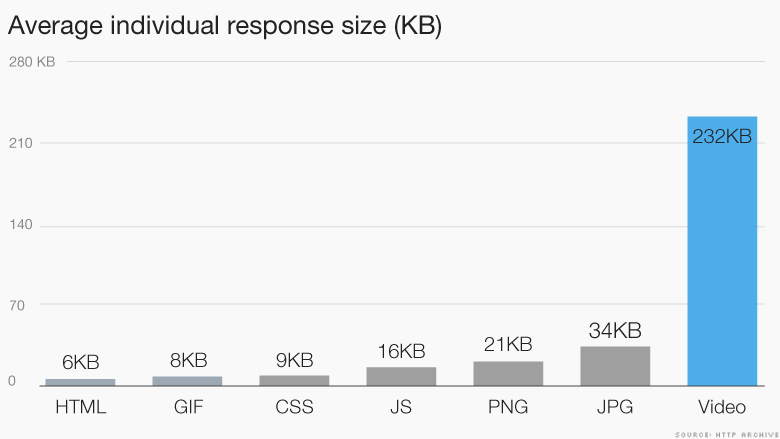
But as more smartphones, tablets, watches and other gizmos are built to go online, developers have to create even more versions of websites and Web components to fit evermore formats. Some websites, for example, have more than 50 different image sizes which can be called upon to load depending on device. This additional complexity requires more code to run, and adds to a website's bulk.
"The shift from desktop to mobile requests and consumption have had the biggest impact on website performance," said Craig Adams, VP of Web experience products at Akamai, a content delivery network that services 15% to 30% of all online traffic daily.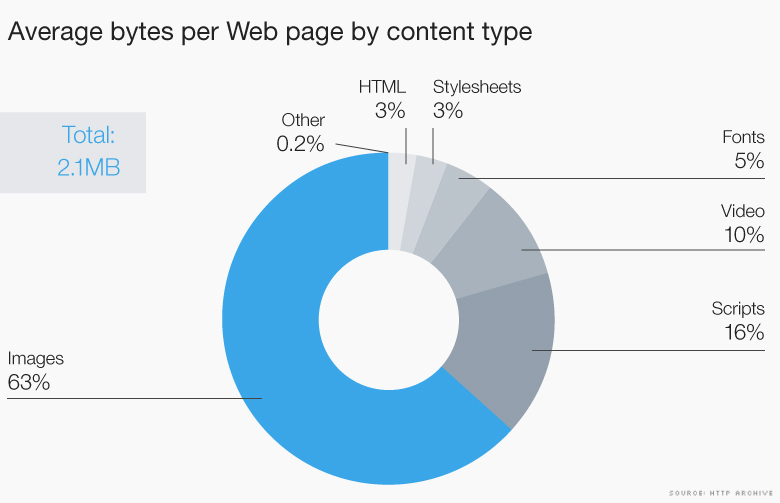
On top of all this, websites are using stronger encryption to make themselves more secure. Shielding themselves behind secured protocols requires more code and data crunching power, too.
The component that has grown the most in size, surprisingly, is custom fonts. Developers are creating unique fonts to differentiate themselves from everyone else online. Three years ago, font transfer size was less than 1% of a webpage's weight, and now the proportion is up to 5%.
There are a variety of other factors that lead to a slower browsing experience, such as network congestion, processing power, browser type, and the number of other programs and tabs you have open.
But all things being equal, the Web is slowing down. It's only slowing by a matter of seconds, but literally every millisecond counts. The slower a Web page loads the more likely it is we'll leave for a competitor's site.
By Hope King @lisahopeking
The spinning wheel of death never seems to stop turning these days.
It's not you. Web pages really are loading slower.
The average site is now 2.1 MB in size -- two times larger than the average site from three years ago, according to data tracked by HTTP Archive.
There are a few reasons for this added weight.
Websites are adding more attention-attracting videos, images, interactivity plug-ins (comments and feeds) and other code and script-heavy features that clog up broadband pipes and wireless spectrum.
Sites also have ramped up their usage of tracking and analysis tools to learn more about their visitors. Inserting third-party data trackers not only increases a website's weight, but also the number of separate data fetching tasks, which leads to slower load times as well.
Photos and videos continue to be the bulkiest part of websites, making up almost three-fourths their size. That proportion has stayed relatively constant over the past three years, even as the total size of websites has grown.
But as more smartphones, tablets, watches and other gizmos are built to go online, developers have to create even more versions of websites and Web components to fit evermore formats. Some websites, for example, have more than 50 different image sizes which can be called upon to load depending on device. This additional complexity requires more code to run, and adds to a website's bulk.
"The shift from desktop to mobile requests and consumption have had the biggest impact on website performance," said Craig Adams, VP of Web experience products at Akamai, a content delivery network that services 15% to 30% of all online traffic daily.
On top of all this, websites are using stronger encryption to make themselves more secure. Shielding themselves behind secured protocols requires more code and data crunching power, too.
The component that has grown the most in size, surprisingly, is custom fonts. Developers are creating unique fonts to differentiate themselves from everyone else online. Three years ago, font transfer size was less than 1% of a webpage's weight, and now the proportion is up to 5%.
There are a variety of other factors that lead to a slower browsing experience, such as network congestion, processing power, browser type, and the number of other programs and tabs you have open.
But all things being equal, the Web is slowing down. It's only slowing by a matter of seconds, but literally every millisecond counts. The slower a Web page loads the more likely it is we'll leave for a competitor's site.
Tuesday, June 9, 2015
Dice: Enterprises are paying premium rates for security expertise
|
Top-level security professionals' salaries are rising as
companies implement strategies for protecting their data from breaches. A
Dice report found that the average compensation for three leading security
positions, including security chief, now exceeds $200,000, well above average
IT salaries.
|
Monday, June 8, 2015
BBC: Millions of US government workers hit by data breach
5 June 2015 BBC
Chinese hackers are suspected of carrying out a "massive breach" of the personal data of nearly four million US government workers, officials said.
The Office of Personnel Management (OPM) confirmed that both current and past employees had been affected.
The breach could potentially affect every federal agency, officials said.
US officials said the hackers were believed to be based in China. Beijing responded by calling such claims "irresponsible".
OPM said it became aware of the breach in April during an "aggressive effort" to update its cyber security systems.
It said it would be contacting all those individuals whose personal data may have been breached in the coming weeks, and offering them 18 months of free credit monitoring and identity theft insurance.
OPM serves as the human resource department for the federal government. The agency issues security clearances and compiles records of all federal government employees.
Information stored on OPM databases includes employee job assignments, performance reviews and training, according to officials.
The breach did not involve background checks and clearance investigations, officials said.
The Office of Personnel Management (OPM) confirmed that both current and past employees had been affected.
The breach could potentially affect every federal agency, officials said.
US officials said the hackers were believed to be based in China. Beijing responded by calling such claims "irresponsible".
OPM said it became aware of the breach in April during an "aggressive effort" to update its cyber security systems.
It said it would be contacting all those individuals whose personal data may have been breached in the coming weeks, and offering them 18 months of free credit monitoring and identity theft insurance.
OPM serves as the human resource department for the federal government. The agency issues security clearances and compiles records of all federal government employees.
Information stored on OPM databases includes employee job assignments, performance reviews and training, according to officials.
The breach did not involve background checks and clearance investigations, officials said.
Wednesday, June 3, 2015
Internet of Things market to triple to $1.7 trillion by 2020 - IDC
Visitors are seen at the SIdO, the Connected Business trade show, in Lyon April 7, 2015. The slogan reads 'The four freedom of free software'.
REUTERS/ROBERT PRATTA/FILES
REUTERS - The global market for "Internet of Things", the concept of connecting household devices to the Internet, will nearly triple to $1.7 trillion by 2020, research firm International Data Corp said.
The IoT market, valued at $655.8 billion in 2014, is set to grow at a compounded annual rate of 16.9 percent, IDC said on Tuesday.
"Devices, connectivity, and IT services will make up the majority of the IoT market in 2020," IDC said. "Together, they are estimated to account for over two-thirds of the worldwide IoT market in 2020..."
Technology firms including Google Inc, Intel Corp, Cisco Systems, Samsung Electronics and telecoms majors including Vodafone and Verizon are betting heavily on Internet device-connected homes for future revenue and profit.
Intel said in February it would buy German network chip maker Lantiq to expand its range of chips used in Internet-connected gadgets.
Google bought smart thermostat and smoke alarm-maker Nest Labs Inc for $3.2 billion last year and Samsung Electronics acquired U.S. start-up SmartThings, which makes software that helps control everything from door locks to light switches in homes, for $200 million.
(Reporting by Lehar Maan in Bengaluru; Editing by Kirti Pandey)
Friday, May 8, 2015
BBC: Microsoft to stop producing Windows versions
BBC


The launch of a new version of Windows used to be a major event
Windows 10 is going to be the last major revision of the operating system.
Jerry Nixon, a Microsoft development executive, said in a conference speech this week that Windows 10 would be the "last version" of the dominant desktop software.
His comments were echoed by Microsoft which said it would update Windows in future in an "ongoing manner".
Instead of new stand-alone versions, Windows 10 would be improved in regular instalments, the firm said.
Mr Nixon made his comments during Microsoft's Ignite conference held in Chicago this week.
In a statement, Microsoft said Mr Nixon's comments reflected a change in the way that it made its software.
"Windows will be delivered as a service bringing new innovations and updates in an ongoing manner," it said, adding that it expected there to be a "long future" for Windows.
Windows 10 is going to be the last major revision of the operating system.
Jerry Nixon, a Microsoft development executive, said in a conference speech this week that Windows 10 would be the "last version" of the dominant desktop software.
His comments were echoed by Microsoft which said it would update Windows in future in an "ongoing manner".
Instead of new stand-alone versions, Windows 10 would be improved in regular instalments, the firm said.
Mr Nixon made his comments during Microsoft's Ignite conference held in Chicago this week.
In a statement, Microsoft said Mr Nixon's comments reflected a change in the way that it made its software.
"Windows will be delivered as a service bringing new innovations and updates in an ongoing manner," it said, adding that it expected there to be a "long future" for Windows.
'No Windows 11'
The company said it had yet to decide on what to call the operating system beyond Windows 10.
"There will be no Windows 11," warned Steve Kleynhans, a research vice-president at analyst firm Gartner who monitors Microsoft.
He said Microsoft had in the past deliberately avoided using the name "Windows 9" and instead chose Windows 10 as a way to signify a break with a past which involved successive stand-alone versions of the operating system.
However, he said, working in that way had created many problems for Microsoft and its customers.
"Every three years or so Microsoft would sit down and create 'the next great OS'," he said.
The company said it had yet to decide on what to call the operating system beyond Windows 10.
"There will be no Windows 11," warned Steve Kleynhans, a research vice-president at analyst firm Gartner who monitors Microsoft.
He said Microsoft had in the past deliberately avoided using the name "Windows 9" and instead chose Windows 10 as a way to signify a break with a past which involved successive stand-alone versions of the operating system.
However, he said, working in that way had created many problems for Microsoft and its customers.
"Every three years or so Microsoft would sit down and create 'the next great OS'," he said.
Microsoft has developed the HoloLens augmented reality system for use with Windows 10
"The developers would be locked away and out would pop a product based on what the world wanted three years ago."
Microsoft also had to spend a huge amount of money and marketing muscle to convince people that they needed this new version, and that it was better than anything that had come before, he explained.
Moving to a situation in which Windows is a constantly updated service will break out of this cycle, and let Microsoft tinker more with the software to test new features and see how customers like them, he added.
"The developers would be locked away and out would pop a product based on what the world wanted three years ago."
Microsoft also had to spend a huge amount of money and marketing muscle to convince people that they needed this new version, and that it was better than anything that had come before, he explained.
Moving to a situation in which Windows is a constantly updated service will break out of this cycle, and let Microsoft tinker more with the software to test new features and see how customers like them, he added.
'Positive step'
Most of the revenue generated by Windows for Microsoft came from sales of new PCs and this was unlikely to be affected by the change, Mr Kleynhans pointed out.
"Overall this is a positive step, but it does have some risks," he said.
"Microsoft will have to work hard to keep generating updates and new features, he said, adding that questions still remained about how corporate customers would adapt to the change and how Microsoft would provide support.
"It doesn't mean that Windows is frozen and will never move forward again," Mr Kleynhans told the BBC.
"Indeed we are about to see the opposite, with the speed of Windows updates shifting into high gear."
Most of the revenue generated by Windows for Microsoft came from sales of new PCs and this was unlikely to be affected by the change, Mr Kleynhans pointed out.
"Overall this is a positive step, but it does have some risks," he said.
"Microsoft will have to work hard to keep generating updates and new features, he said, adding that questions still remained about how corporate customers would adapt to the change and how Microsoft would provide support.
"It doesn't mean that Windows is frozen and will never move forward again," Mr Kleynhans told the BBC.
"Indeed we are about to see the opposite, with the speed of Windows updates shifting into high gear."
Subscribe to:
Posts (Atom)